• This is default featured slide 1 title

    Go to Blogger edit html and find these sentences.Now replace these sentences with your own descriptions.This theme is Bloggerized by NewBloggerThemes.com.

  • This is default featured slide 2 title

    Go to Blogger edit html and find these sentences.Now replace these sentences with your own descriptions.This theme is Bloggerized by NewBloggerThemes.com.

  • This is default featured slide 3 title

    Go to Blogger edit html and find these sentences.Now replace these sentences with your own descriptions.This theme is Bloggerized by NewBloggerThemes.com.

  • This is default featured slide 4 title

    Go to Blogger edit html and find these sentences.Now replace these sentences with your own descriptions.This theme is Bloggerized by NewBloggerThemes.com.

  • This is default featured slide 5 title

    Go to Blogger edit html and find these sentences.Now replace these sentences with your own descriptions.This theme is Bloggerized by NewBloggerThemes.com.

DOCUMENTARY REVIEW: The Biggest Little Farm

(Image: variety.com)

(Image: variety.com)

THE BIGGEST LITTLE FARM — 4 STARS

Sometimes the craziest ideas become the most fulfilling ones when they come to fruition. In 2010, wildlife cameraman John Chester and his private chef wife Molly decided to merge their interests and turn their lives upside-down. Combining his respect for nature with her excitement for food, the Chesters gave up city living in Los Angeles to move an hour north and start a true traditional farm that exists harmoniously with nature. In the hands of an artist and filmmaker, The Biggest Little Farm takes would look like a capricious and half-hearted whim fit for a green reality show on basic cable and turns the the documented endeavor something ambitious, important, and miraculous.

This documentary introduces the audience to Apricot Lane Farms on the brink of potential disaster. The scorched earth of the Southern California wildfires of 2017 caused by the worst drought in 1200 years are creeping closer to three sides of the place the Chesters have come to regard higher than merely a home business. With that “never dream we would ever get to this point, where we have so much to lose” threat unanswered until later, the film takes us back to the genesis. Jason Carpenter’s charming animated sequences paraphrase and visualize the thought process that began as a promise to a family dog named Todd.

Over the next seven years stamped as chapters, The Biggest Little Farm examines the arduous path the Chesters chose to build a meaningful life of purpose in Moorpark, California. Fostered by agricultural consultant Alan York, Apricot Lane Farms was planned down to the molecule to achieve the highest level of biodiversity possible. That’s organic and free-range to the nth degree when you hear and observe York help the Chesters transform 200 acres of dried and dead valley land into a lush and vibrant new ecosystem designed to produce and sustain simplicity in all this diversity.

LESSON #1: IT ALL STARTS AT THE CELLULAR LEVEL — Dig through your old elementary science years and you may remember many food chain and food web lessons sorting producers, consumers, predators, and prey. The proper conditions for the success of Apricot Lane Farms starts at the forgotten link of the food chain that people turn those noses away from: the decomposers. Remember the creepy and crawling things that ate dead stuff? That’s where the basics of enriched soil begin at the microbial level. Without soil, nothing can grow and no animals can eat.

True to one thing’s trash is another thing’s treasure, Alan York’s piece-de-resistance for the Chesters was a liquid composting process that “alchemized death to life.” Beginning with a cover crops that put roots in the ground and “energized by the impermanence of life,” the renewed plant life jump-started the evolution of the next bigger things. Over the steady expansion to 200 plant and animal varieties, Apricot Lane’s efforts are merged with the surrounding environment to create a symbiotic habitat of renewal and challenges to balance the needs of the farm with the needs of nature.

LESSON #2: FARMING IS HARD WORK AND HIGH COST — Though the camera’s eye on the subject paints gorgeous serenity, nothing about what you’re watching is easy. A veteran farmer (including this writer’s grandparents) will tell that farmers are the biggest gamblers in the world. At different points of triumph and adversity, innumerable factors of science, heart, blood, sweat, tears, finances, support, trust, and good old Mother Nature graced or beset John and Molly Chester and their admirable plight. It took years to see returns on investments that overcame the losses.

Thanks to John’s Emmy-winning production background work, The Biggest Little Farm makes the perilous and painstaking looks sumptuous and rich, all backed by a lovely musical score by Jeff Beal. The dynamic and striking natural photography comes from voluminous combined work of John Chester and four other cinematographer collaborators including fellow Emmy winners including Mallory Cunningham and Kyle Romanek, TV doc specialist Benji Lanpher, and Chris Martin covering the time-lapse sequences. The sweep across close-ups, slow-motion, and vista work from drones is entirely captivating. As usual, the MVP of every documentary is the editor and Amy Overbeck crafted a tidy, yet compelling 91-minute gem.

LESSON #3: LET’S DO MORE OF THIS — The story of The Biggest Little Farm may be a niche, but it has the power to inform and inspire similar wellsprings of progressive innovation and change. Their expansive experiment shows that establishing equilibrium and responsible land use can still net results, feed our society, and improve the planet that keeps us alive. The work of Alan York and the Chesters should be shown in every classroom in America, young and old, to spark a few more humble dreamers like them to take up this cause.

LOGO DESIGNED BY MEENTS ILLUSTRATED (#787)

LOGO DESIGNED BY MEENTS ILLUSTRATED (#787)

Permalink


from REVIEW BLOG - Every Movie Has a Lesson http://bit.ly/2W2AJ9r

Share:

MOVIE REVIEW: Godzilla: King of the Monsters

(Image: nypost.com)

(Image: nypost.com)

GODZILLA: KING OF THE MONSTERS— 2 STARS

Midway into this sequel, a sweaty and flustered Kyle Chandler, far from the “clear eyes, full hearts” of Friday Night Lights, uses his character’s expertise to remark on a penetrating sound coming from one of the tentpole’s mega monsters. He indicates the audible shriek declares a want for one of three things that start with F: food, fight, or, as he censors, “something more intimate.” Fill in the blank as you will. You’re going to groan a few grunts of your own too during Godzilla: King of the Monsters, and they won’t be matching of those three particular F words. Instead, they will be flummox, frenzy, and frustration.

After Gareth Edwards rebooted the legendary Japanese sea monster for a modern audience with a stern seriousness and hefty scope that destroyed all previous campiness connected to the character, this Michael Dougherty-helmed follow-up burns up all of that renewed credibility right away within the first half-hour on through to the exhausting end. Where’s the blame? That would be the humans because the behemoths really come out to play. Bad quippy comedy, nonsensical plot trappings, and unimportant character inclusions are the true weaknesses that defeat these monsters.

Chandler’s central hero is Dr. Mark Russell, a former Monarch specialist who has not handled the familial loss that came to him during the San Francisco destruction of the 2014 film. His now-divorced wife, Dr. Emma Russell (Vera Farmiga), and daughter Madison (Stranger Things starlet Millie Bobby Brown) have remained with the clandestine scientific organization studying the other “titans” that have been discovered since the shocking public disaster five years ago. Emma has continued the work of her spouse to develop the Orca, the key MacGuffin of the movie that can tuned to emulate the bio-sonar signals of these beasts.

LESSON #1: GET YOUR FREQUENCIES STRAIGHT — Much like those F-word signals mentioned earlier, the exactitude of the Orca is paramount to human chances of success. Watch that digital dial. You don’t want to mix up your battle cries with your mating calls.

The intelligence of this movie’s fictional science ends there when Emma sides with eco-terrorist Alan Jonah (played by professional movie villain Charles Dance) a former military colonel who’s out for the big business of kaiju DNA. All the Monarch good guy spooks and scientists can do, led by the returning experts Serizawa and Graham (Ken Watanabe and Sally Hawkins) and flanked by newcomers Bradley Whitford, Thomas Middleditch, Zhang Ziyi, is recruit Mark with a classic “there’s no one better than you” arm-twist to chase his wife around the globe as Jonah’s team breaks into Monarch outposts and releases new gestating and dormant nightmares. Reading all those human details, whatever happened to “let them fight?”

LESSON #2: STOP FORCING CHARACTERS NO ONE CARES ABOUT — Each time, the human narrative seems to run its course and the action can commence between Godzilla, the multi-headed Ghidorah, the fiery-winged Rodan, and the luminous Mothra, the people and their flimsy motives of environmental cleansing, radiation, gambling, balance, and what not keep getting in the way. The entire big-bomb-centered military element with David Strathairn, O’Shea Jackson, Aisha Hinds, and Anthony Ramos are as random and underwritten as the scientists. When a blunt “you’re a monster” is the sad peak of the burn level of human care and intensity, it’s time to aim higher. Stop cutting to the humans. We came for the monsters.

LESSON #3: DON’T STAND THERE AND STARE — And while we’re on this topic, cinematographer Lawrence Sher’s unpinned camera catches more gawking than an audience at an opera concert in a movie that should churn like a meat grinder. Take a cue from the original Japanese targets and run! If you’re going to include and put this much attention on the people, please have them doing something more interesting than all this.

While the portly and performance-captured Godzilla (stuntman extraordinaire T.J. Storm) and his opponents of immense and insane cinematic scale lack feral gracefulness and lumber little better than when they used to be portrayed by actors in rubber suits, the throwdowns of Godzilla: King of the Monsters, when not interrupted by Lessons #2 and #3, are toy-smashing wish fulfillment for raucous fans. The promise of a larger world of threats from the MonsterVerse of Godzilla and Kong: Skull Island is sizably answered. Composer Bear McCreary’s filler-ish score is a minor improvement to orchestrate this reptilian rumba stomping on cities. There is awesomeness to be found, if you can see or hear it clearly.

The final bit of trouble with Godzilla: King of the Monsters is its scrambled layers of noise. Godzilla’s trademark roar, as imposing and cool as it is when loosed, barely stands out in a messy sound mix of indeterminable clutter elsewhere. With enough precipitation haze and colored cumulonimbus clouds to make even The Weather Channel give up and wish for a clearer day of textures, the fight scenes are often shrouded, dark, and very difficult to follow. Even with the heavyweight sights present, the dimming effect of 3D on this dingy palette cannot be recommended. The three-man editing team macheted the satiating slugfest we wanted with the bumbling calamities and preposterous survival saves of the people we don’t care about. This movie will have its loyal audience, but it is a creative step back for the MonsterVerse.

LOGO DESIGNED BY MEENTS ILLUSTRATED (#786)

LOGO DESIGNED BY MEENTS ILLUSTRATED (#786)

Permalink


from REVIEW BLOG - Every Movie Has a Lesson http://bit.ly/2KekjZw

Share:

MEDIA APPEARANCE: David Ehrlich's IndieWire Critics Survey on May 28, 2019

indiewirelogo.jpg

Notable and notorious IndieWire film critic David Ehrlich recently put out a social media call for film critic peers to join a weekly survey to discuss movie topics, answer questions, and highlight their work.  Representing Every Movie Has a Lesson, I, along with over 60 other emerging and established film critics including some of my fellow Chicago Independent Film Critics Circle members and Aaron White of Feelin’ Film, accepted the invitation to participate.  I'm honored by the opportunity, and I hope my responses are chosen each week.  


Screen Shot 2019-05-28 at 5.50.22 PM.png

THIS WEEK'S QUESTION: What is the worst movie ever and why?

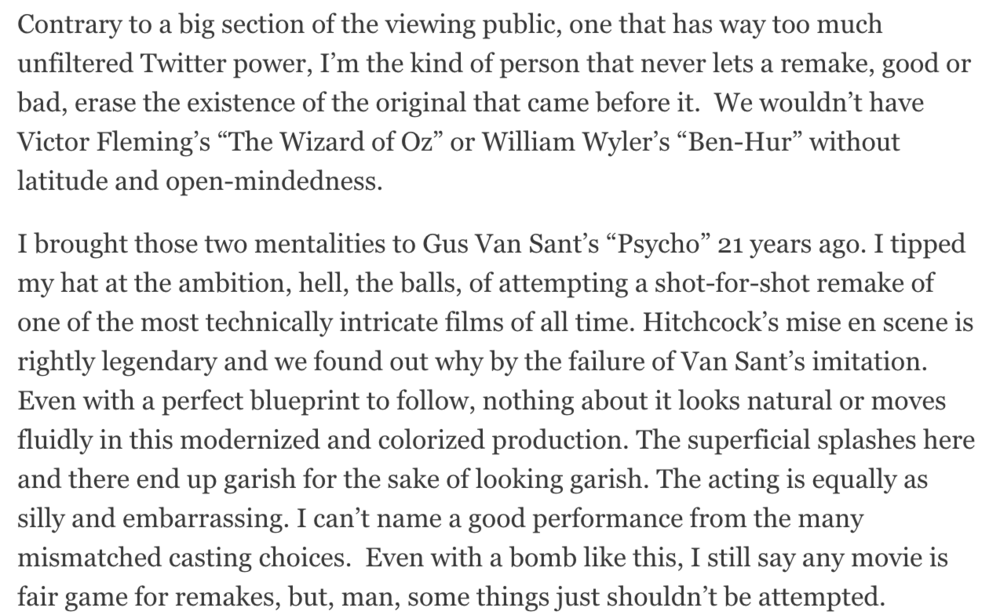
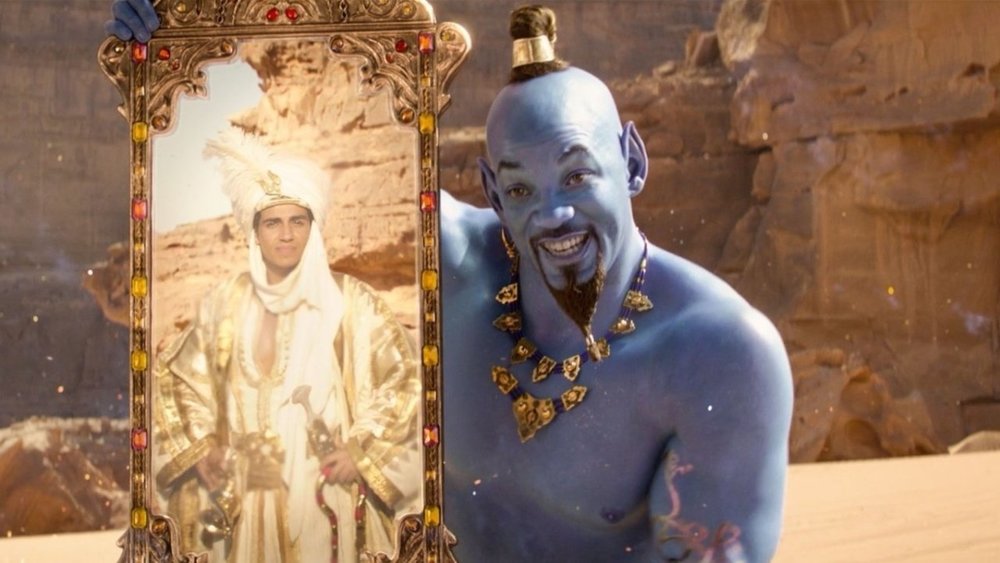
Not too many critics are taking too kindly to Disney re-imagined Aladdin. I see the appeal, but it’s far from a great remake. That said, it’s far from the worst too. By golly, have there been some stinkers. This week’s IndieWire critics survey from David Ehrlich polled for the ugliest of the ugly and got ten selections. For the second survey in a row, I went to the 1990s, this time for Gus Van Sant’’s reviled Psycho remake. Misguided isn’t even the beginning of it. Any other choice here was going to be a distant second for me.

Screen Shot 2019-05-28 at 5.51.00 PM.png Screen Shot 2019-03-25 at 10.26.15 PM.png Screen Shot 2019-05-28 at 5.51.20 PM.png THE FULL INDIEWIRE ARTICLE THIS WEEK LOGO DESIGNED BY MEENTS ILLUSTRATED

LOGO DESIGNED BY MEENTS ILLUSTRATED

Permalink


from REVIEW BLOG - Every Movie Has a Lesson http://bit.ly/2Wb5X2X

Share:

EDITORIAL: Movie Casino Cheats

Untitled presentation.jpg

Can we learn anything from the most famous casino cheats in movies?

There’s a very good reason why casinos make an appearance in so many films. They contain all the elements needed for a gripping drama. They’re naturally glamorous locations filled with the beautiful and wealthy, where fortunes being won or lost on the turn of a card or the spin of a roulette wheel. Last, but not least, they give the hero of the film the chance to use their wits or skill to get the better of both the casino and the other players who are pitted against them.

In some movies, like the Ocean’s series starring Brad Pitt and George Clooney, this takes the form of pulling off a major heist – but in others it’s a question of letting the characters in the film bend the rules to tip the odds in their favor. This celebration of rule breaking makes for a captivating spectacle for viewers, some of whom might well be inspired to try the techniques shown on screen.

Of course, we can’t condone this kind of behavior – and in some cases it’s simply too fantastical to copy. However, here are five great movies which go to show that sometimes cheats really can prosper.


The Sting (1973)

Following the massive box office success of Butch Cassidy and the Sundance Kid this follow-up again starred Paul Newman and Robert Redford. The action takes place in  Depression-hit 1936 with the pair playing a couple of grifters called Henry Gondorff and Johnny Hooker. The complex plot revolves around the pair’s efforts to cheat a violent gangster called Doyle Lonnegan, played by Robert Shaw, out of thousands of dollars. But first they have to reel him in to the scam which they do in a highly charged poker game on board a glamorous train called the 20th Century Limited.

Newman plays a bookmaker called Shaw who challenges Lonnegan to a game of poker and lulls him into a false sense of security by behaving like a boorish drunk. But as the scene plays out, we discover that both men are cheating by using extra cards – but Newman is a little better at it in the end and humiliates his foe by winning. So while direct cheating like this would never be acceptable, the principle of pretending to be a worse player than you really are could certainly be an effective techniques.

Chances of working: 6/10


Rain Man (1988)

This 1988 classic starring Dustin Hoffman and Tom Cruise was the landmark movie that introduced mainstream audiences to the concept of card counting in blackjack. For the uninitiated, this is the observation of which high number cards are yet to be dealt from the pack, or packs, in play. This helps the player estimate the likelihood of being able to beat the dealer – thus tipping the odds in their favor.

In the movie Hoffman plays the autistic brother of Cruise, an opportunistic con-artist who harnesses the former’s uncanny ability to memorize cards with the objective of winning big in the casino. This works well for the pair – until the casino catches on to what’s occurring and they are unceremoniously asked to leave. If you were ever to be found doing the same there’s a fair chance that the same would happen to you – as Hollywood A-lister Ben Affleck found out to his cost in 2014.

However, some gamblers have been pulling it off for years. If you want to sharpen your skills, using an effective card counting training guide would be a good place to start. In the worst case scenario, you’ll be banned from a casino. In the best, you’ll become a millionaire. In our opinion, it’s a chance worth taking.

Chances of working: 9/10


21 (2008)

Widely acknowledged to be the best blackjack movie ever, 21 is all the more remarkable because it’s based on a true story about a casino scam that went on for a couple of decades from the late 1970s onwards. Again, card counting was used to get the edge over casinos but, instead of autistic savants, the perpetrators were brilliant mathematicians from the Massachusetts Institute of Technology.

In the film they are recruited by their professor, just as they were in real life. The difference is that, in 21, the character is played by Kevin Spacey who divides the students into teams who work in unison to take casinos to the cleaners. Communicating with signals and code words, they spend the movie making a fortune. But, the harsh reality of the real world intrudes as the casinos are set to introduce biometric screening to catch them out. So they make a final visit to Vegas in heavy disguise. Does it work out for them? You’ll just have to watch the movie to discover.

Again, card counting works. In this case, it actually did. So it stands to reason that it is undeniably one of the more successful forms of casino cheating. You just need to have superhuman focus, courage and memory – a combination very few people actually have.

Chances of working: 9/10


Casino (1995)

Martin Scorsese had a tough act to follow after the global success of Goodfellas – but he made a pretty good job of it with this offering from 1995. Marking the twilight years of the mafia’s involvement in Las Vegas and featuring many of the actors from his previous mob movie including De Niro and Joe Pesci plus Sharon Stone too. It also included an object lesson in why it was a big mistake to cheat, especially in those days. Casino manager Pesci catches a couple indulging in “spooking”, otherwise known as spying on the dealer’s cards.

Needless to say, he doesn’t just take the cheats aside for a quiet word. He offers one of the spookers the option of walking away empty handing or taking his punishment. He chooses the latter which, as anyone who’s seen the film will know, was a very bad move.

Chances of working: 4/10


Beyond the Edge (2018)

Our final example is a recent release in Russia, which hinges on the concept of a team with super intelligence and telekinetic powers who decide to use them to win a fortune at a casino. For example one member can use mind power to direct a roulette ball into the winning number, another can scramble electronic devices like slots machines.

It’s a fantastical story, and one that mere mortals, lacking the psychic powers of someone like Uri Geller professes to have, couldn’t hope to emulate. If you tried something like this in a casino, you’d get laughed all the way out to the car park – and trolled for life on social media. However, it’s such a gripping story that we wouldn’t be surprised to see Hollywood picking up the story and transferring the action to Las Vegas very soon indeed.

Chances of working: 1/10

LOGO DESIGNED BY MEENTS ILLUSTRATED

LOGO DESIGNED BY MEENTS ILLUSTRATED

Permalink


from REVIEW BLOG - Every Movie Has a Lesson http://bit.ly/2W8SvNi

Share:

MEDIA APPEARANCE: Guest on the "Kicking the Seat" podcast talking "John Wick: Chapter 3 - Parabellum"

Kts1.png Kts2.png

With guns blazing and some fun editing, Ian Simmons of Kicking the Seat was kind enough to invite me for his podcast roundtable for John Wick: Chapter 3 - Parabellum. I came into this as a neophyte where I hadn’t seen any of this series before prepping for the third. David Fowlie of Keeping it Reel and Emmanuel Noisette of E-Man’s Movie Reviews and to this circle and we all approach this one quite uniquely. Reload with us and enjoy the critiques!

MY FULL "JOHN WICK: CHAPTER 3 - PARABELLUM" REVIEW LOGO DESIGNED BY MEENTS ILLUSTRATED (#17)

LOGO DESIGNED BY MEENTS ILLUSTRATED (#17)

Permalink


from REVIEW BLOG - Every Movie Has a Lesson http://bit.ly/2XaOlRf

Share:

MOVIE REVIEW: Aladdin

(Image: comicbook.com)

(Image: comicbook.com)

ALADDIN — 2 STARS

It is becoming increasingly tedious to both critique and enjoy these Disney “re-imaginings.” The teeter-totter between familiarity and freshness changes with each movie due to the modern desire to update and the soaring fan expectations set by the level of nostalgic adoration carried for each previous property. Diverge with heart and charm and you get the perfect Pete’s Dragon. Veer with questionable revisions or gaudy spectacle and you get the maligned Maleficent. Imitate and emulate with affection and you get Beauty and the Beast or Cinderella. Mix new tones with old ones for homage that don’t match and you get The Jungle Book and Dumbo. The results have been wildly mixed.

Where does the new Aladdin balance on this cinematic seesaw? That would be quite middle with a tilting lean that could go either way. The studio and Sherlock Holmes series director Guy Ritchie aimed admirably with an “ambitious and non-traditional” take employing minority casting against whitewashing and colorism. Those skin-deep improvements are progressive, but who are we kidding? The color that mattered most was blue. All the desired diversity in the world paled to who could possibly follow the late Robin Williams? The Genie is the ticket to more than just wishes when it comes to this reboot’s success.

That laborious task was given to Will Smith. Folks, he is a hot, baking sun of swagger! Will has not been this loose and free since Men in Black 3 seven years ago. Aladdin reminds us how much of a consummate showman the 50-year-old is and always has been. Will has a style, energy, and stage presence all his own, and he saves this entire movie from sandy ruin.

In front of The Genie’s winking and bejeweled human form and his sizable and mystical sapphire sinew is a slightly thickened story true Disney fans know by heart. A handsome “street rat” sneaker named Aladdin (Canadian-Egyptian newcomer Mena Massoud of Hulu’s Jack Ryan) catches the appreciative and alluring eye of Jasmine (pink Power Ranger Naomi Scott), the Princess of Agrabah, an independent spirit lamenting the trappings of her regal stature and required betrothal to fellow royalty. The handsome hustler also gains the prophecy-fulfilling curiosity of Jafar (Marwan Kenzari of Ben-Hur), the hypnotizing top advisor to the Sultan (12 Strong’s Navid Negahban), who is convinced the young man is the human key to the Cave of Wonders and a certain handheld beacon that likes being caressed by fingertips.

LESSON #1: EXCEEDING ONE’S INITIAL OR CURRENT PLACE — The moral dilemma of Aladdin has not changed. We have many “waited my whole life”-spewing characters trapped by their present or past places in society, complete with the corresponding weaknesses of confidence that accompany those tiers. Birthright, caste, hierarchy, gender, legislation, and other constraints like that pesky lamp all stand as potential causes. As the film and one of its new songs implores, too many good people are “seen and not heard.” Truthful resolve and manufactured personal improvement are the dueling paths sought to change one’s “speechless” or limited circumstances.

Heading back to the symbolic piece of playground equipment, the casting and performances in Aladdin are one step forward and two steps back. Massoud and Scott represent closer matching minorities for the affair and their attractive chemistry together has smoldering warmth. Massoud’s winning smile will swoon many. For today’s empowering present, Scott’s Jasmine was positively bolstered with layers of independence and, thankfully, less sexualization than previous incarnations. As an avian cherry on top, less Gilbert Gottfried, as in zero Gilbert Gottfried, is a blessing to the eardrums.

Unfortunately, the not-so-thin varnish of multiple unfavorable Arabic and Asian tropes, from accents to character behaviors, smears the rest of the human landscape of Aladdin. Negahban’s Sultan, for example, is terribly one-dimensional where even the doting towards his daughter is too slight to resonate as regality. The bigger vacuum is the main villain. Kenzari’s Jafar suffers from underwritten motivation and a somewhat unimposing performance. Had the same updating attention given to the Jasmine role been extended to that character by writers John August (Dark Shadows) and Guy Ritchie, the overall improvement could have increased the storytelling heights.

LESSON #2: REPRESENTATION ISN’T ENOUGH — The on-and-off irregularity of Aladdin is a unique situation. Yes, it is wonderful Disney sought people of color for this ethic fairy tale, but the clout of their portrayals and the substance of their actions are not improvements. If you’re going to do the right thing by diversity, go all the way, not just halfway or selectively. Dare to combat stereotypes completely.

Little expense was spared on the ritzy designs of Aladdin but that wavering imbalance affected the artistic and technical side as well. The prolific female team of production designer Gemma Jackson (Finding Neverland) and set decorator Tina Jones (Assassin’s Creed) created expansively hued settings of showy detail. Oscar-nominated costume designer Michael Wilkins (American Hustle) adorned the cast of thousands occupying those stages with fabulous frock and studly threads. The surface is sadly where the effectiveness ends.

The digitally created depth behind the practical elements fails to impress. The vistas cannot keep up and do not blend well with the work Jackson, Jones, and their teams. The same can be said with the physicality. The urban parkour puppeteered by experienced stunt coordinator Adam Kirley and the incredible dance choreography by Jamal Sims (the second MVP of the picture who also doubles for Will Smith) bound with kinetic vivacity only to be sullied by unsteady and questionable editing that makes the twirls, swirls, and flourishes choppy.

The final hot-and-cold component of Aladdin is its rich music. Just as he did for 2017’s Beauty and the Beast revival, composer Alan Menken returned to his Oscar-winning score and songs. His involvement was vitally essential to maintaining a level of glow for the movie. The execution, however, is the tedious part. The new songs from the songwriting duo of Pasek and Paul (La La Land, The Greatest Showman) are too slight or misplaced in their moments. Massoud and Scott may look the parts, but their vocals cannot quite achieve all that is necessary for “A Whole New World,” arguably Disney’s greatest duet song in their expansive catalog (a bar that was, forgivably, not going to be topped). Once again, Will Smith and Jamal Sims save the day. Where the pipes fail on the audio tracks, the punchy footwork and gyrating gambols on camera provide the dazzle, making one wonder and wish Aladdin could have gone full Bollywood. Guy Ritchie used to have that panache so it’s surprising not to see on the biggest stage.

LOGO DESIGNED BY MEENTS ILLUSTRATED (#785)

LOGO DESIGNED BY MEENTS ILLUSTRATED (#785)

Permalink


from REVIEW BLOG - Every Movie Has a Lesson http://bit.ly/2EtbHKP

Share:

CAPSULE REVIEWS: Feature films of the 7th Chicago Critics Film Festival

(Website: chicagocriticsfilmfestival.com)

(Website: chicagocriticsfilmfestival.com)

For the seventh consecutive year, many of the best domestic and international films on the festival circuit come to Chicago thanks to the Chicago Film Critics Association.  The 7th Chicago Critics Film Festival began May 17th at the famed and restored Music Box Theatre.  Steaming towards a decade in successful existence, the CCFF remains the only film festival curated by film critics in the nation.  This year, 25 feature films and two short film programs comprise their rich and ambitious offering slate.  

For the third year in a row, Every Movie Has a Lesson will be credentialed to cover this fine spread of movie offerings.  Ranked in order of recommendation, here are my capsule reviews for the feature films. Full pieces coming later when the respective films have their proper release:


THE FAREWELL

(Image: variety.com)

(Image: variety.com)

Drawing from a deeply personal story, director Lulu Wang’s second feature film shines comedy and drama on a culturally unique situation of gallows humor.  Ocean’s 8 and Crazy Rich Asians breakout Awkwafina stars as Billi, a Chinese-American struggling writer who learns the news that her beloved grandmother Nai Nai (Zhao Shuzhen) back home in Changchun has stage 4 lung cancer and presumably little time left to live.  The kicker comes in a heavy layer of dramatic irony created by cultural norms. It is tradition that those terminally ill are not told their diagnosis of inevitable truths, a decision weighing on everyone that Billi disagrees with.  As an excuse to bring everyone home to see Nai Nai, the family throws a shotgun wedding. Torn between celebrating on the inside and grieving on the inside, everyone tries to make the best in emotional and often hilarious results and releases.  Even with this divergent practice happening, the universal human condition feels are extremely strong in one of the most entertaining and freeing film experiences of recent memory. Indie champion A24 has another winner, Wang is a renewed artistic talent, and Awkwafina’s star grows even greater.  This Sundance darling is primed to be a summer favorite of counterprogramming come this July.

HIGHEST RECOMMENDATION


YESTERDAY

(Image: chicagocritics.org)

(Image: chicagocritics.org)

Academy Award winner and Trainspotting captain Danny Boyle teams with all-star British romantic comedy writer Richard Curtis for one of the most unique cinematic love letters to pop culture you may ever see.  Dream-chasing singer-songwriter Jack Malik (EastEnders cast member Himesh Patel) catches a break when his body gets broken in a bike vs. bus accident at the precise moment the entire planet experiences an electrical blackout.  When he comes to and heals up, Jack awakens to world, including the stalwart woman of his life (Lily James), that has never heard of The Beatles and the their music. Possessing a gold mine of borrowed inspiration, Jack begins to record and perform their catalog as if they were his own creative output, drawing the wild attention and popularity of the music industry and captive audiences.  Yes, the premise is preposterous, the happenstance and romance are cloying, but, by golly, is Yesterday energetic, intriguing, and endlessly charming.  Beyond the plot holes, the brilliance of The Beatles is at its center.  It makes you wonder if the Fab Four’s half-century-plus old lyrics and rhythms would capture audiences with the same love and universal appeal as they did in their actual time?  Likewise, what makes their music so great, the song or the performer? Yesterday is a wonderful fantasy playing out these possibilities through trancing, crowd-pleasing song and serenade.

HIGH RECOMMENDATION


OLYMPIC DREAMS

(Imdb.com)

(Imdb.com)

In a deft and ambitious sample of guerilla filmmaking, the husband-and-wife team of director Jeremy Teicher and athlete/actress/writer Alexi Pappas used the Artist-in-Residence program led by the Olympic Foundation for Culture and Heritage to compose a plucky and Linklater-esque romance in, around, and during the active 2018 Winter Olympics in PyeongChang, South Korea.  Notable star (and contributing co-writer) Nick Kroll plays a volunteer dentist named Ezra from the states who has jumped at the opportunity to serve and be a part of the Olympic experience. Ezra enters wide-eyed and fanstruck only for the buzz to wear off and remind him how alone he really is at this point in his life after a dissolved marital engagement back home.  With a kind and curious heart, Ezra chats up another homesick and forlorn soul in Penelope (Pappas), an American cross-country skier who has already lost her event and finds herself overwhelmed by the immediate end and disappointment of all that personal work and build-up. Over the course of a few days, weaving all throughout the host city and facilities, the two embark on shared quality time and brewing romantic possibilities.  With advantageous, authentic, and awesome production value, Olympic Dreams carries a very unique and unexplored setting which includes the smooth and charismatic involvement of dozens of non-actors and real athletes filling its settings and scenes.  Olympic Dreams feels like a swift-yet-patient Meet Cute romance hidden inside a voyeuristic documentary and travelogue that moves and breathes with caring and considerate tones from start to finish.  This is a hidden gem.

HIGH RECOMMENDATION

COMING SOON: Saint Frances, and the shorts programs on their own article

LOGO DESIGNED BY MEENTS ILLUSTRATED

LOGO DESIGNED BY MEENTS ILLUSTRATED

Permalink


from REVIEW BLOG - Every Movie Has a Lesson http://bit.ly/2EnyVSl

Share:

Blog Archive

Recent Posts

Unordered List

  • Lorem ipsum dolor sit amet, consectetuer adipiscing elit.
  • Aliquam tincidunt mauris eu risus.
  • Vestibulum auctor dapibus neque.

Sample Text

Lorem ipsum dolor sit amet, consectetur adipisicing elit, sed do eiusmod tempor incididunt ut labore et dolore magna aliqua.

Ut enim ad minim veniam, quis nostrud exercitation test link ullamco laboris nisi ut aliquip ex ea commodo consequat.

Theme Support

Need our help to upload or customize this blogger template? Contact me with details about the theme customization you need.