• This is default featured slide 1 title

    Go to Blogger edit html and find these sentences.Now replace these sentences with your own descriptions.This theme is Bloggerized by NewBloggerThemes.com.

  • This is default featured slide 2 title

    Go to Blogger edit html and find these sentences.Now replace these sentences with your own descriptions.This theme is Bloggerized by NewBloggerThemes.com.

  • This is default featured slide 3 title

    Go to Blogger edit html and find these sentences.Now replace these sentences with your own descriptions.This theme is Bloggerized by NewBloggerThemes.com.

  • This is default featured slide 4 title

    Go to Blogger edit html and find these sentences.Now replace these sentences with your own descriptions.This theme is Bloggerized by NewBloggerThemes.com.

  • This is default featured slide 5 title

    Go to Blogger edit html and find these sentences.Now replace these sentences with your own descriptions.This theme is Bloggerized by NewBloggerThemes.com.

MOVIE REVIEW: Wicker

Images courtesy of Black Bear

WICKER— 5 STARS

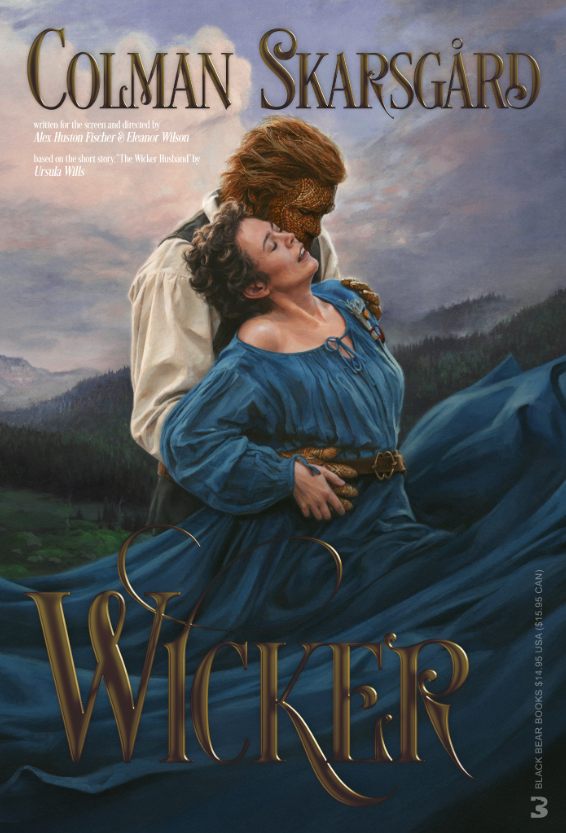
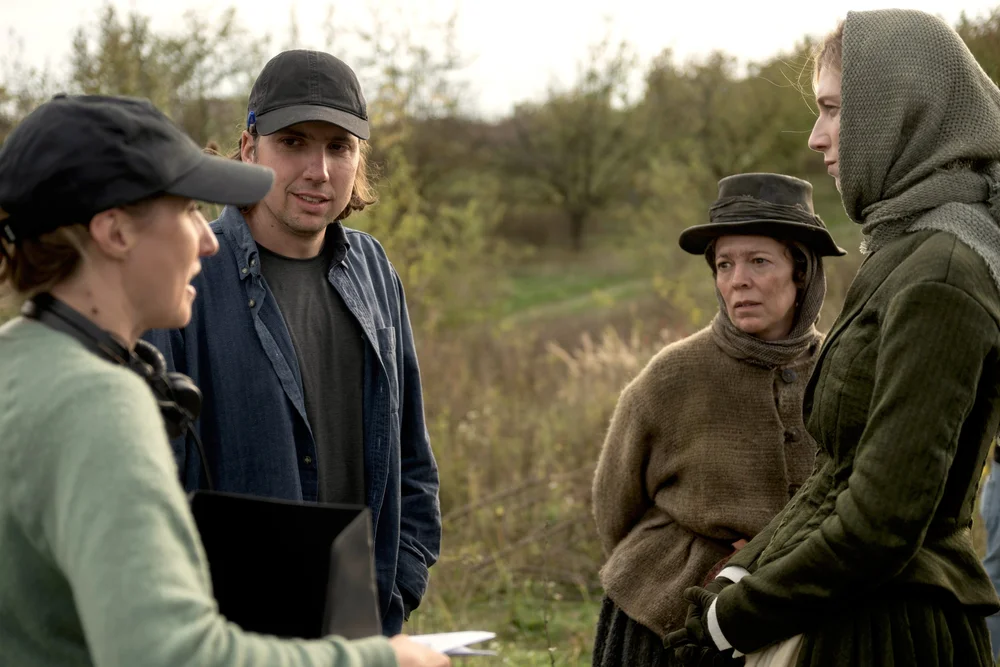
I cannot help but watch the brilliant film, Wicker, the sophomore feature film from the Save Yourselves! directing duo of Alex Huston Fischer and Eleanor Wilson, and see an analog comparison to Spike Jonze’s Oscar-nominated 2013 masterpiece Her. The two films couldn’t be farther apart in terms of polish and setting, yet the narrative goals for finding substantial love from artificial, yet affirming places are wholly unified. Wicker’s thought-provoking weirdness, arresting beauty, utter honesty, and intoxicating charm strike all the same unforgettable chords.

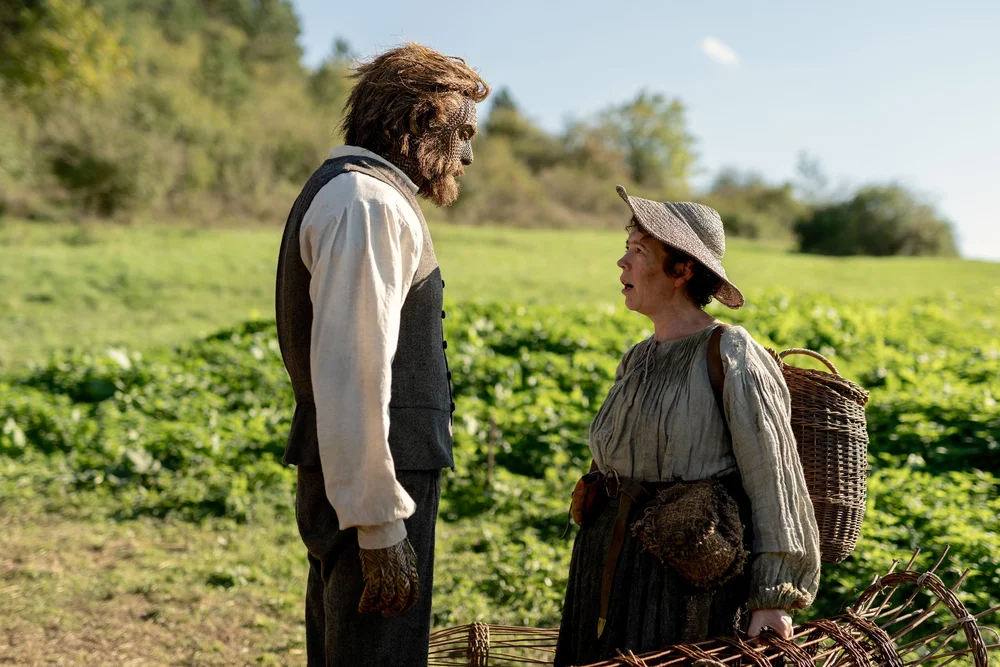
Set in the pre-colonial era and filmed in the rural countryside outside of Budapest, Hungary, Wicker focuses on a spinster woman played by The Favourite Academy Award winner Olivia Colman. Like everyone in her nearby village, she is named for her familiar place or given profession: Fisherwoman. Looked down upon and openly ridiculed by most all for her late age, uncouth attitude, and smelly aura, Fisherwoman lives a solitary life of labor and the occasional crass retort while other citizens appear to thrive with marriage and family. She would love to see her fortunes change in that department and seeks out the travelling Basket Weaver (Emmy winner Peter Dinklage) to work a miracle. 

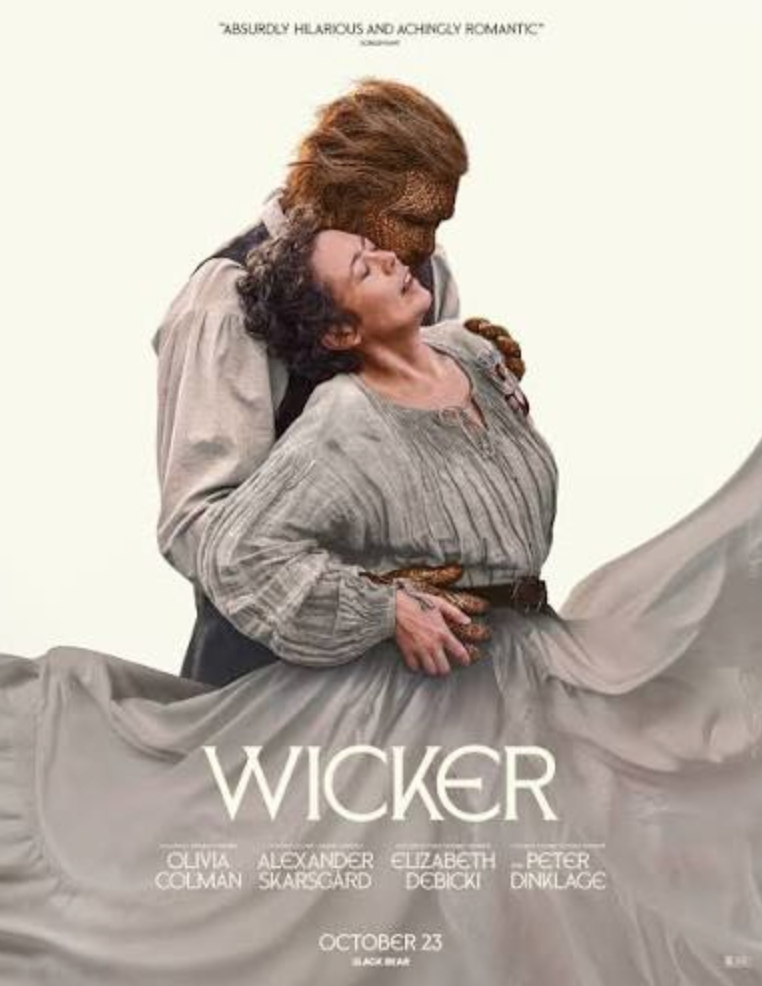
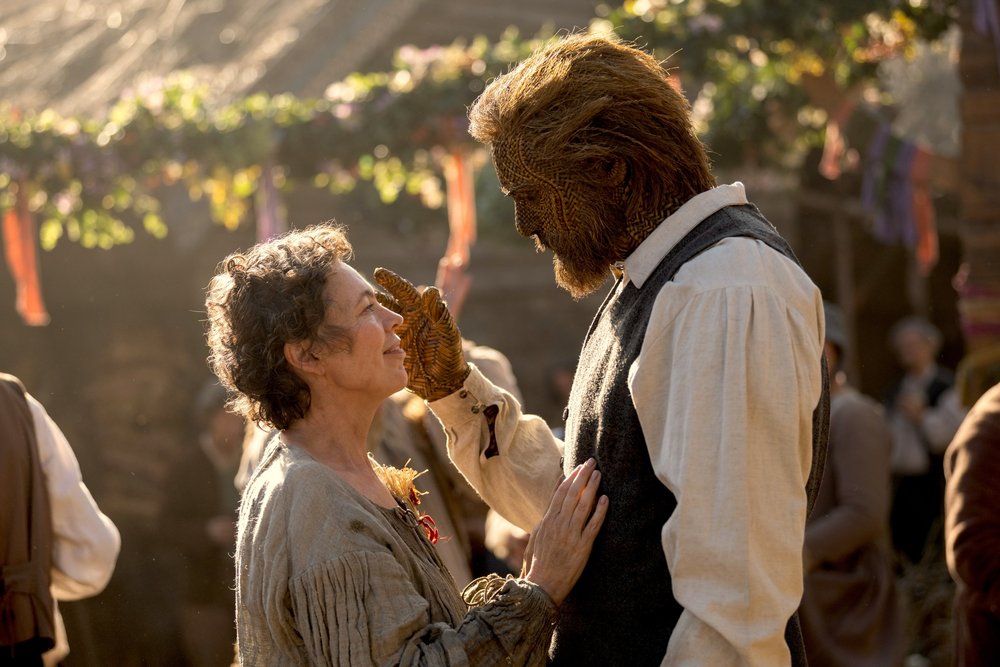
She pays him to “make me a husband,” a tall task for the highly creative and flamboyant craftsman, but one fitting his “has there ever been a more righteous endeavor” ambition. Augmenting Mother Nature like a cross between Victor Frankenstein and Bob Ross, Basket Weaver delivers the Wicker Husband, a strapping figure played underneath a guise of prosthetic makeup and a slight varnish VFX by the ageless heartthrob Alexander SkarsgÃ¥rd. Fibrously woven from different gauges of reeds and willows, the anatomically correct man is not only perfectly built but takes to Fisherwoman immediately.

LESSON #1: EXPERIENCING UNCONDITIONAL LOVE— Husband has been enlivened to unconditionally love Fisherwoman not like a pet or servant, but as a romantic and physical equal. Quite simply, his entire thankful existence is to put her first; the socially lonely Fisherwoman has never experienced this level of doting and dutiful affection before, and almost doesn’t know what to do with it. Before this, she doubted love and questioned the worth of marriage. Yet, this companionship is a lightning bolt to her heart, unlocking confidence she never knew she had and satisfaction she never knew she needed.

LESSON #2: CAN LOVE COME FROM ARTIFICIAL SOURCES?— This striking development in Wicker counts as love crossing a not-so-new line to artificial sources and whether—spiritually, morally, or whatever supposed stress of importance one wants to impart on the matter—this is truly fulfilling, healthy, and proper. Like Joaquin Phoenix’s introverted Theodore Twombly in Her finding “Samantha,” or Ryan Gosling’s titular character in Lars and the Real Girl toting around a life-sized doll, Fisherwoman is a better person with Husband in her life. That has to count for something, traditions be damned.

With this new chapter of life and existence, Wicker indeed widens the world to play out this concept for public reaction. Once Fisherwoman and Husband step out publicly at a village wedding, the gossip mill—working mostly through Elizabeth Debicki’s Tailor’s Wife (a sly supporting role as a foil to Colman)—grinds and churns with a myriad of reactions. It’s not necessarily the shock that Fisherwoman has a spouse, but the fact he is so perfect and behaviorally different than every other man in town. Thick with this layer of satire, Wicker’s village is principally populated by unaffectionate, job-focused, surly, fallible, and unromantic men and husbands who want their women at home tending to the house and making babies. They are zero help and grant little freedom in return.

LESSON #3: THE JEALOUSY OF EQUALITY AND WORTH— Pulling from the short story "The Wicker Husband" by Ursula Wills, Alex Huston Fisher and Eleanor Wilson play with these angles of dichotomy with richly dark humor laced with romantic longing. The film offers several cheeky encounters of voyeuristic townspeople reacting to this oddly harmonious union with varying degrees of jealousy. Either the women want a slice of that type of helpful and missing equality in their lives, or the men see their worth being embarrassingly reduced by being shown up by this new figure. Soon, the fun of that external jealousy can bleed into harsher pushback in Wicker.

While challenges certainly lie ahead, the rapturous beauty of Wicker is both in its detailed creation and its positive conviction to put this kind of romance out into the world. Lit by sprawling and favorable cinematography from The Brutalist’s Oscar-winning Lol Crawley and backed by a luscious acoustic score from Scottish composer Anna Meredith, the glow of Olivia Colman is the star of the show, and that’s quite a feat considering the craft fair blue ribbon vessel joining her. The ingenious makeup work of Zsomber Agoston, Zsofia Otvos, Sarah Rubano, and the prosthetics designed by Joe Dunckley (District 9) used to transform Alexander SkarsgÃ¥rd are extraordinary; combined with the puppeteer movements from Callum Lingard, every audible split and visible crinkle creates tangibility that fancy green screens and performance capture shortcuts cannot match.

Beyond these treats, the unexpected romance is the largest draw of Wicker. Through both the eyes and bodies of Colman’s beleaguered woman and SkarsgÃ¥rd’s newborn innocence, the outward displays of passion are incredibly sweeping. As soon as SkarsgÃ¥rd utters a line like “I was made to be with you” with his low purr of diction, the heat rises as it should. The movie is unafraid to shift ways to see and feel beauty, even through—and especially through—artificial sources. What makes her happy makes him happy, and not the over-traditional other way around, and that simple stance speaks volumes. Wicker’s lifts given to a woman’s independence and the proper devotion a spouse should give their partner create harmony sorely missing in the world.

W_R_00016.jpg
W_R_00057.jpg
W_R_00010.jpg
image (1).png
W_R_00029.jpg
image.png
W_R_00045.jpg

LOGO DESIGNED BY MEENTS ILLUSTRATED (#1440)

Permalink


from Review Blog https://ift.tt/N5cXHLb

Share:

Francesco Dalli Cani Undergoes Six-Month Physical Transformation for Supernatural Thriller ‘Fallen’

The Italian actor takes on the dual roles of a tormented priest and a fallen angel in an ambitious short film exploring faith, redemption and the possibility of salvation.  Italian actor Francesco Dalli Cani is taking his commitment to character transformation to an extraordinary level in Fallen, a supernatural horror short film that required six […]

The post Francesco Dalli Cani Undergoes Six-Month Physical Transformation for Supernatural Thriller ‘Fallen’ appeared first on Movie Marker.


from Movie Marker https://ift.tt/UFoHbnc
Share:

What Muay Thai Movies Teach About Discipline

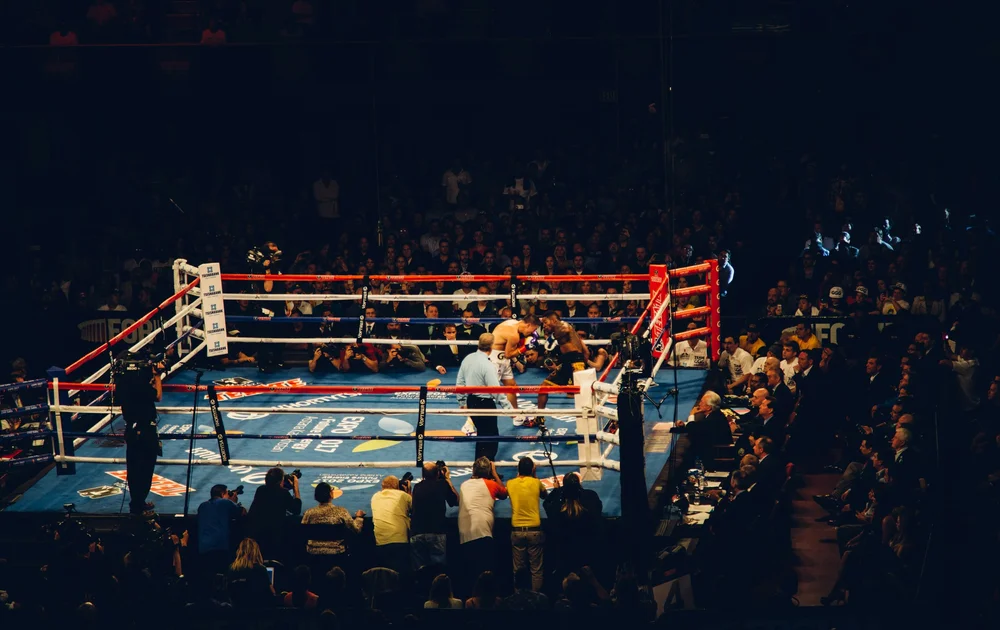
Fight films love a training montage. Muay Thai films go further, because the sport arrives with its own rituals, rhythm and code of respect. Watched closely, the best of them teach lessons that hold up long after the last knee strike.

Photo by Payam Tahery on Unsplash

Many viewers finish these films curious about the real sport in Thailand. Adults who want it can follow Thai fight cards on thsport, a Thai-language sports news site, but its odds pages apply only where betting is legal. The lessons below come first, though, and they start with the movies themselves.

Why Does Muay Thai Look So Good On Screen?

Muay Thai lets fighters strike with fists, elbows, knees and kicks. That variety gives a camera far more to follow than a boxing jab. Every exchange can end in a different way.

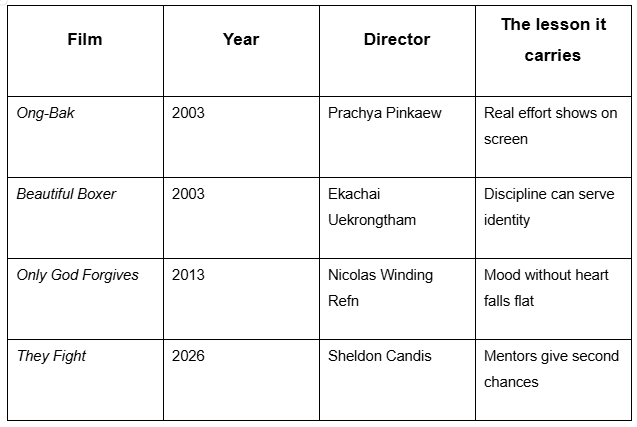
The film that proved it to global audiences was Ong-Bak in 2003. Prachya Pinkaew directed, and Tony Jaa played Ting, a villager chasing a stolen Buddha statue. A Kung Fu Kingdom retrospective notes that Jaa had trained for years as a stuntman under action director Panna Rittikrai. He also studied Muay Boran, the older form of Muay Thai, for the role.

The same review says no CGI or wires were used for the stunts, and Jaa performed his own. That choice is the first lesson. Audiences can feel when a body is doing the real work.

What Lessons Do These Films Share?

Strip away the plots and a few ideas repeat across the genre. Each one applies well outside the ring.

  1. Respect comes before the first punch. Fighters perform the wai kru ram muay before a bout. A Muay Thai Records guide translates it as paying respect to the teacher through dance and boxing.

  2. Finishing matters more than starting. Real judges weight the later rounds most heavily, so a fast start proves little.

  3. The body keeps the receipts. The best of these films show training as repetition, pain and patience rather than one inspired moment.

  4. Style cannot replace stakes. Don Shanahan gave Only God Forgives one star, arguing that substance beats style every time.

  5. Setbacks invite a comeback. The boxing drama They Fight pushes the idea of always fighting back against what holds you down.

Beautiful Boxer from 2003 may carry the deepest version of these lessons. Directed by Ekachai Uekrongtham, it tells the true story of Nong Toom, played by real kickboxer Asanee Suwan. A review in Eye For Film describes how Toom turns to Muay Thai to earn money for a sex change. The film treats discipline as a way to become who you are.

How Different Is a Real Bout From a Movie Fight?

Movie fights last exactly as long as the story needs. Real professional bouts follow a fixed clock. Under New Jersey's Muay Thai regulations, professionals fight up to five rounds of three minutes each. They get a one-minute rest between rounds.

Photo by Joel Muniz on Unsplash

The scoring lesson is the surprising one. Those same rules say round one is generally scored 10-10 unless one fighter clearly dominates. Rounds three, four and five must be scored decisively for one fighter. The regulations compare a Muay Thai bout to a marathon, because how a fighter finishes counts most.

That is the opposite of a movie edit, which often front-loads the flashiest moves. Films also skip the slow grind of the clinch. New Jersey's rules allow fighters to twist and dump an opponent to the canvas from a neck clinch, a skill that rarely makes a highlight reel. The ritual survives on screen, though. New Jersey's rules let the referee start the fight only after both fighters finish their pre-fight rituals, in keeping with Thai tradition.

The sport's reach keeps growing too. In July 2021, the 138th IOC session in Tokyo gave Muay Thai's world body full IOC recognition. The Nation reported that the federation had members in 146 countries at the time.

Which Films Make a Good Muay Thai Double Bill?

Pair these by the lesson you want, not just by the fight scenes.

Ong-Bak and Beautiful Boxer make the strongest pairing. Both arrived the same year, and both show two very different reasons to step into a ring.

Only God Forgives works best as a contrast piece. Watch it after Ong-Bak and the gap in purpose becomes obvious. One film builds every fight around a goal its hero cares about. The other leans on mood and leaves the fights hollow. They Fight then brings the lesson home, with a coach who uses the gym to rebuild his own life.

What Should Fans Know Before Reading Fight Odds?

Following the real sport often leads fans to Thai sports sites, and some of those pages publish fight odds. A few plain facts help keep that in proportion.

  • Thailand restricts gambling tightly. AustCham Thailand notes that the Gambling Act of 1935 permits only a limited range of activities, such as the Government Lottery Office draw.

  • Odds are not a forecast you can beat. Every price includes a bookmaker's margin, so the house holds the edge over time.

  • Legality is local. Betting is for adults only, and only where the law allows it.

  • Help is free. In the United States, the National Problem Gambling Helpline answers at 1-800-MY-RESET (1-800-697-3738). In Thailand, the Department of Mental Health runs the 1323 hotline around the clock.

The safest way to enjoy fight odds is as one more piece of analysis, not as a plan.

Frequently Asked Questions

What Is the Wai Kru Ram Muay?

It is the ritual dance a fighter performs before a bout. The phrase translates roughly as paying respect to the teacher through dance and boxing. Each gym and trainer lineage shapes its own version.

Is Beautiful Boxer a True Story?

Yes. The 2003 film follows the real fighter Nong Toom, who used Muay Thai earnings to pay for a sex change. Real kickboxer Asanee Suwan plays the lead role.

How Long Is a Professional Muay Thai Bout?

Under New Jersey's rules, a professional bout runs up to five rounds of three minutes. Fighters get one minute of rest between rounds. Later rounds weigh most heavily in scoring.

Is Betting On Muay Thai Legal In Thailand?

Thailand's Gambling Act of 1935 permits only a narrow range of gambling, and most betting is banned. Readers elsewhere should check their own local laws. Betting is for adults only, and only where it is legal.

Leaving the Theater With the Right Lesson

Muay Thai films work best when they respect the sport's code as much as its kicks. Ong-Bak teaches effort, Beautiful Boxer teaches identity, and the weaker films teach what happens without heart. Real bouts add one more lesson the movies often skip. The finish matters most, in the ring and outside it.

Permalink


from Review Blog https://ift.tt/bop1UP6

Share:

Cannes Palme D’Or Winner, Major Previews And City-Wide Screenings Announced For 2026 Inverness Film Festival

The Inverness Film Festival will be returning for its 24th year (13-19 November) with an ambitious programme spanning international cinema, highly anticipated new releases, documentaries, and Scottish filmmaking. As part of Eden Court’s 50th anniversary celebrations, the festival will take cinema beyond its usual screens with IFF: On Location – three classic films shown in […]

The post Cannes Palme D’Or Winner, Major Previews And City-Wide Screenings Announced For 2026 Inverness Film Festival appeared first on Movie Marker.


from Movie Marker https://ift.tt/V857YOe
Share:

How to Check an Online Gaming Platform Before Signing Up

Photo by Branden Skeli on Unsplash

There’s a download button on the screen. The page looks right. But the address isn’t quite the one in your bookmarks, and after ten minutes of searching, you’re tempted to just tap it and move on. That small mismatch is exactly what’s worth stopping for before you use mega888 online casino malaysia as a search term to pick a website or app.

Here’s the problem. A brand name spreads much faster than the business behind it. Several pages can borrow the same logo and colours, and a polished design says nothing about who’s actually running things. So start with where you’ve landed, not how it looks.

A Name Is Not the Same as an Operator

Who’s responsible for this website? That’s the question to answer next. The terms of use and privacy policy should give you something solid to look at. A company name tucked into the footer doesn’t help much if you still can’t tell which business runs the service or where a complaint would go.

Say a site claims to be licensed. Don’t take the badge at face value, since anyone can paste one onto a page. Look the claim up in the regulator’s own records, if they’re publicly available. If the names or licence details don’t match, treat the claim as unverified.

One missing detail on its own isn’t proof of anything. Still, if you can’t work out who the operator is and you can’t confirm what the site says about itself, signing up won’t answer those questions for you.

When an App Download Goes Wrong

Picture this. You’re halfway through installing the app and it fails. A new page pops up with a different file, promising this one will work. It’s frustrating, and that frustration is what makes people click. The replacement file might have nothing to do with the original service, and the page offering it rarely says who made it.

If the instructions tell you to switch off your phone’s security settings, don’t. Be just as careful with files that arrive in messages you didn’t ask for. When you can’t independently confirm where something came from, leave it alone.

Before installing anything, ask yourself:

  • Where did the file come from? A link from a stranger isn’t a reliable source, however friendly the message sounds.

  • What happens if setup fails? Being pushed to install file after file is a signal to stop.

  • Who’s asking for your login details? Don’t send passwords or one-time verification codes to a “support” contact over chat.

That last one catches people out, usually when the person on the other end sounds helpful or in a hurry. Keep those codes to yourself. Someone knowing the platform’s name doesn’t make them trustworthy.

Personal Details and Payment Rules

Signing up can mean handing over more than a username. Some services want your phone number. Some want a copy of your ID. Before you send either, read the privacy policy. What does the operator say it collects? And how do you close your account if you change your mind?

If the policy is vague on the basics, don’t rush the form. Use a password you haven’t used for your email or your bank. Turn on two-step verification if the site offers it.

Money raises its own questions. Check the deposit and withdrawal rules first, then look for fees and limits. Promotions are worth a second look, too. A “100% welcome bonus” might come with wagering conditions that make it far less generous than the headline suggests, so read the fine print before you transfer anything.

If you’re comparing services linked to Mega888 Malaysia, run these checks on the specific site or app you’re considering. The name by itself doesn’t prove a page is official. It doesn’t prove two sites share an operator, either, or that a payment claim holds up.

Watch out for anyone who says you need to pay a fee to unlock your winnings or “fix” a stuck withdrawal. That’s a classic pressure tactic. Don’t send more money because a request feels urgent. Check it independently first.

Permalink


from Review Blog https://ift.tt/oalMT1G

Share:

Tailoring the Betting Experience to Each Bettor's Interests

Bettors are not interchangeable. One follows a single sport closely, another spreads bets across many, a third only ever engages around big events. A sportsbook that treats them all the same buries each of them under content they do not care about. Meeting bettors with what actually interests them is what makes the experience feel relevant rather than noisy.

Delivering that relevance is the job of capable sports betting software solutions, which have to shape what each bettor sees around the sports they actually follow. Soft2Bet, a leading iGaming turnkey solutions provider delivering high-quality products and services for online gambling operators, builds its platform to make the betting experience relevant to the individual rather than generic to everyone.

Specialist at a computer tailoring markets with sports betting software solutions

Relevance Beats Volume

A sportsbook that shows every bettor everything asks each of them to do the sorting. Most will not, they will simply tune out the content that does not match their interests. Relevance flips that: when a bettor is met with the sports and markets they follow, the experience feels made for them, and they engage rather than filter.

This is not about pushing bettors toward anything, it is about respecting what they already care about. A bettor who follows a particular sport wants to find it quickly, see the markets that matter to them, and not wade through everything else. Tailoring the experience to genuine interest is a matter of relevance and convenience, plain and simple. There is nothing manipulative about showing a bettor the sports they already follow first, it is simply good service. A sportsbook that respects what a bettor came for feels considerate, and consideration is something bettors notice and return to.

What Tailoring Involves

Making a sportsbook relevant to the individual comes down to organising the experience around what each bettor actually follows.

Tailoring the experience typically means:

  • surfacing the sports a bettor follows
  • highlighting the markets relevant to them
  • keeping favoured events easy to reach
  • reflecting a bettor's stated preferences
  • reducing the noise of content they ignore

Different Bettors, Different Needs

The value of tailoring is clearest when you consider how different bettors actually behave. A dedicated follower of one sport wants depth in it, a broad bettor wants easy access across many, an occasional bettor wants the big events front and centre. A single, undifferentiated layout serves one of them at the expense of the others.

Meeting each on their own terms is what a tailored experience does. Rather than forcing every bettor through the same generic front page, the sportsbook adapts to reflect what each one follows, so the experience feels considered rather than one-size-fits-all. That consideration is part of what keeps a bettor choosing one sportsbook over another.

Relevance Depends on the Platform

Tailoring the experience to each bettor is only possible if the platform supports it. Understanding what a bettor follows and organising their experience around it takes a foundation built for that kind of relevance, not a fixed layout that shows everyone the same thing regardless of interest.

This is where the platform underneath makes the difference. A sportsbook built to reflect individual interest can meet bettors with what matters to them at scale, across a whole audience, without manual effort. Relevance stops being something an operator does by hand and becomes something the platform delivers as a matter of course.

Conclusion

Bettors reward a sportsbook that feels like it understands what they came for, and they drift from one that buries their interests under everyone else's. Tailoring the experience to each bettor's genuine interests, on a platform built to do it at scale, is one of the clearer ways to make a sportsbook feel considered rather than generic.

Turning that relevance into lasting engagement is where the rest of the platform contributes. Soft2Bet adds MEGA (Motivational Engineering Gaming Application), its gamification engine, so a relevant experience also has more ways to keep bettors coming back.

Permalink


from Review Blog https://ift.tt/Gi04vh8

Share:

With Healey Reportedly Eyeing a Slot Machine Tax Rise on 28 October, Has British Cinema Ever Really Nailed the Lure of the Fruit Machine?

Chancellor John Healey stands up to deliver his first Budget on 28 October, and the line item exciting the most lobbying in pubs, arcades, bingo halls and casinos is a dull one: Machine Games Duty, the tax on fruit machines and every other cash prize machine in the country. Reports say the Treasury is weighing […]

The post With Healey Reportedly Eyeing a Slot Machine Tax Rise on 28 October, Has British Cinema Ever Really Nailed the Lure of the Fruit Machine? appeared first on Movie Marker.


from Movie Marker https://ift.tt/cCQKHdB
Share:

PODCAST: Episodes 247 of "The Cinephile Hissy Fit" Podcast

For their 247th episode, two fearful film critics, two mind-reading dads, and two web-slinging school teachers, Will Johnson and Don Shanahan, had a new conversation spin away from the usual format. What started as a chat on the runaway sensation Spider-Man: Brand New Day became an advance therapy session for the state of the Marvel Cinematic Universe with Avengers: Doomsday looming this December. For years, this show's mantra has been "Trust Kevin Feige." That might not be the case at the moment. Come learn more and stay for the mutual love and respect that fun movies encapsulate. Enjoy our podcast!


Cinephile Hissy Fit is an Astra Award-losing Film Obsessive media podcast, brought to you by the Ruminations Radio Network, and a member of the Critics Choice Podcast Network. Please visit, rate, review and subscribe. If you enjoyed this show, we have more where that came from, with interesting hosts, and wonderful guests. All are available on iTunes, Spotify, and anywhere you find your favorite shows. Follow the show on Twitter at @CinephileFit and on Facebook. Also, find both Will Johnson and Don Shanahan on Letterboxd as they accumulate their viewings and build their ranks and lists. Lastly, check out their TeePublic store for merchandise options from stickers to t-shirts!

Thank you so much for your captive audience and social media participation! Enjoy our new podcast episode!


Ruminations Radio Network website Spotify iTunes Transistor
Don Shanahan on Letterboxd Will Johnson on Letterboxd

Permalink


from Review Blog https://ift.tt/LT9va1B

Share:

Beyond the Casino Floor: How Streaming Is Bringing Gambling Thrillers Back into Focus

For decades, gambling films have been associated with glamorous casinos, expensive suits and dramatic confrontations across card tables. Yet some of the genre’s most compelling stories take place far from the polished surroundings of Las Vegas, focusing instead on damaged characters, desperate decisions and the psychological consequences of chasing an unlikely victory. Streaming has created […]

The post Beyond the Casino Floor: How Streaming Is Bringing Gambling Thrillers Back into Focus appeared first on Movie Marker.


from Movie Marker https://ift.tt/p17ishl
Share:

Sweet Bonanza Slot Review

Photo by Erik Mclean on Unsplash

Sweet Bonanza, launched by Pragmatic Play on June 25, 2019, is a cascade-style video slot game with a fruit and candy theme. Since its introduction, Sweet Bonanza has evolved into a series, but this review focuses on the original 2019 release.

Sweet Bonanza at a Glance

Feature

Details

Provider

Pragmatic Play

Release Date

25/06/2019

Grid

6×5

RTP

96.48% (reported; may vary by configuration)

Volatility

High

Win Mechanic

8+ matching symbols anywhere on the grid

Free Spins Trigger

4+ Scatter symbols

Initial Free Spins

10

Maximum Bomb Multiplier

100×

Maximum Win

21,175×

Sweet Bonanza Gameplay

6×5 Grid

Sweet Bonanza's gameplay takes place within a 6×5 grid of colourful symbols, laying out a candy-loaded screen. The candies, fruits, and lollipop symbols are the result of crisp and colourful art design.

How Winning Combinations Work

Winning combinations are formed by matching 8, 9, 10, 11, or 12 or more of the same symbol. This means that you must collect enough matching symbols to form a win. A winning combination doesn't need to follow a horizontal or diagonal payline, as is traditional in slot games. Instead, you need to land at least 8 of the same fruit or candy symbols (eight is the minimum), regardless of their position on the grid.

Sweet Bonanza will pay the highest symbol payout tier if you land 12 or more of the same symbol. So, if you land 12 of the same fruit, you'll generally win a smaller prize than if you land 12 red heart candies. Two slots can look almost identical and still pay very differently for the same number of matching symbols. That’s worth remembering when comparing games on Casina Portal — the paytable tells you far more than the graphics.

Tumble Feature

After a winning combo, the winning symbols disappear and the reels tumble to give you the chance to land a new or bigger win. This makes each paid spin capable of producing several consecutive payouts. New icons appear on the screen and subsequent wins are awarded as they occur.

Sweet Bonanza Symbols and Payout System

Fruit Symbols

The five fruit symbols, banana, grapes, watermelon, plum, and apple, are among the lowest-paying. You need 8 of the same fruit to win a prize, and wins go up progressively for 10, 11, and 12 or more matching fruits.

Candy Symbols

Typically, the higher payouts come from the candy icons. There are 4 different coloured candies, each one offering different prize values. The red heart candy is the highest-paying, with wins of 10× for 8 or 9 hearts becoming 50× if you land 12 or more.

Lollipop Scatter

The lollipop is a special Scatter symbol that can also award a payout. When 4 or more lollipops land on the grid, you'll trigger a Free Spins bonus, with the Scatter payout increasing when additional lollipops land.

Multiplier Bombs

Multiplier Bombs can award multipliers ranging from 2× to 100×. You can accumulate these multipliers during the same tumble sequence, so it's possible to combine several bombs into a much larger multiplier.

Sweet Bonanza Free Spins

How to Trigger Free Spins

The Free Spins feature is triggered when four or more Scatter symbols land.

Number of Free Spins

Sweet Bonanza launches the bonus with 10 Free Spins — whether you enter the bonus with four, five, or six lollipops. You get a higher Scatter payout for additional lollipops on the triggering spin: five lollipops give you 5× your bet, six lollipops give you 100× your bet, while four lollipops award 3× your bet, with 10 Free Spins granted in each case.

Retriggering the Feature

The number of times you can retrigger Free Spins is not fixed at 100, and five additional free spins are awarded whenever at least three lollipop Scatters land during the bonus.

Multiplier Bombs During Free Spins

If a multiplier bomb lands during the bonus round, the player can receive a multiplier of up to 100× on a winning tumble. If there are multiple multiplier bombs, their values are combined together and applied to the total tumble win.

Sweet Bonanza Tumble Feature

The Tumble feature is at the core of Sweet Bonanza. Winning matches disappear from the grid, but non-winning symbols remain. New symbols then cascade down to fill the gaps, allowing for more wins from a single paid spin. The feature continues until no new winning combination appears.

Sweet Bonanza isn't the only slot where one spin can lead to several wins. Spilloversikt.com also explains how cascading reels work in Megaways games, where the number of ways to win changes from spin to spin.

With cascading wins, each spin may give you several payouts. If the Tumble feature produces another winning combination, you'll see a new payout before the next tumble, allowing the sequence to continue without an additional wager.

Understanding Sweet Bonanza's RTP

Standard RTP

Sweet Bonanza's commonly reported RTP is 96.48%, which falls within the typical range for modern online slots, although individual game configurations may differ.

Sweet Bonanza has a notable feature in its bonus round: the random multiplier bombs. These randomly awarded multipliers are included in the RTP calculations, and they're available only during Free Spins.

What RTP Does and Does Not Mean

Return to Player (RTP) specifies the theoretical expected return from the game to the player, expressed as a percentage. In other words, the RTP corresponds to how much of the money wagered on a slot machine is returned to players over the long term.

The site https://bestcasinos.gr/ helps the player understand all the rules of slots.

This percentage is a theoretical one calculated over a large number of spins using the game's mathematical model rather than a player strategy. So, while the RTP figure represents an expected average return across a massive number of spins, it doesn't specifically apply to a smaller number. It doesn't serve as a prediction for a player's outcome after 100, 1,000, or 10,000 spins.

Sweet Bonanza Volatility

During its launch in 2019, Pragmatic Play classified Sweet Bonanza as a high-volatility game. While substantial payouts may be less frequent, their potential size can be relatively large.

What Does a High Volatility Slot Machine Mean?

In a high-volatility slot game, larger payouts generally occur less frequently, meaning players may experience longer periods without a substantial win. A low-volatility slot game, in contrast, has more frequent, but generally smaller payouts.

Sweet Bonanza Maximum Win

Sweet Bonanza offers a maximum return of up to 21,175× your stake. This should not be confused with wins announced for later versions like Sweet Bonanza 1000 and Sweet Bonanza 2500.

Sweet Bonanza Bonus Features

Free Spins and 100× Multiplier Potential

After triggering 10 Free Spins in the bonus round, each bomb can boost your win by up to 100×, and the combined multiplier means you could substantially increase your winnings.

Extra Free Spins and Tumbles During the Bonus

Keep in mind that landing 3 or more Scatter symbols during Sweet Bonanza Free Spins will award five additional spins. The number of extra spins depends on the lollipops that land during the Free Spins feature, rather than any strategy the player can control.

Sweet Bonanza Design and Theme

The game's vibrant visual style is meant to evoke a playful, colourful aesthetic. Colors and graphics are bright and expressive, creating a lively atmosphere. The sound effects are energetic, helping to give the reels a distinctive rhythm. However, the game's overall style and aesthetic are simple, with no narrative or backstory involved.

Sweet Bonanza vs Sweet Bonanza 1000

Feature

Sweet Bonanza

Sweet Bonanza 1000

Release

2019

2024

Grid

6×5

6×5

Multiplier ceiling

Up to 100×

Up to 1,000×

Maximum win

Up to 21,175× the original bet

Up to 25,000× the original bet

Pragmatic Play described the 1,000× multiplier in Sweet Bonanza 1000 as 10 times the original game's multiplier.

Sweet Bonanza vs Sweet Bonanza 2500

The latest addition to the series, Sweet Bonanza 2500, was released on April 30, 2026. It introduced two key changes:

  1. The multiplier ceiling increased to 2,500×, up from 1,000× in Sweet Bonanza 1000.
  2. The maximum advertised win reached 25,000× the original bet, up from 21,175× in the original game.

Permalink


from Review Blog https://ift.tt/AprV4Yf

Share:

Luis Hindman’s ‘Magid/Zafar’ Crowned 2026 Winner Of Iris Prize

The organisers of the Iris Prize LGBTQ+ Film Festival – celebrating global stories and Cardiff charm are proud to announce that director Luís Hindman has won the prestigious Iris Prize supported by The Michael Bishop Foundation for his film Magid / Zafar.  The announcement was made this morning (18 October) at the BBC Cymru Wales […]

The post Luis Hindman’s ‘Magid/Zafar’ Crowned 2026 Winner Of Iris Prize appeared first on Movie Marker.


from Movie Marker https://ift.tt/aJzk2Zr
Share:

Interview With Director Rhys Marc Jones (Black Church Bay)

Playing at this year’s London Film Festival, as well as closing out the 20th anniversary edition of Cardiff’s Iris Prize. Black Church Bay is a tense drama set in a small Welsh village, centred on school teacher Barry (Tom Cullen), who is leading a double life. When an intimate encounter with a younger man, Jasper […]

The post Interview With Director Rhys Marc Jones (Black Church Bay) appeared first on Movie Marker.


from Movie Marker https://ift.tt/bDy6zn5
Share:

Iris Prize Unveils Best British Award Winners For 2026

The organisers of the Iris Prize LGBTQ+ Film Festival – celebrating global stories and Cardiff charm are thrilled to announce that the winner of the Iris Prize Best British Short Film Award sponsored by Film4 and Pinewood Studios is Darius Shu, for Molly. Darius produced Queer Parivaar, which won Best British Short at Iris Prize 2022 […]

The post Iris Prize Unveils Best British Award Winners For 2026 appeared first on Movie Marker.


from Movie Marker https://ift.tt/n8WhqvX
Share:

MOVIE REVIEW: The Plea

Images courtesy of the Woodstock Film Festival

THE PLEA— 4 STARS

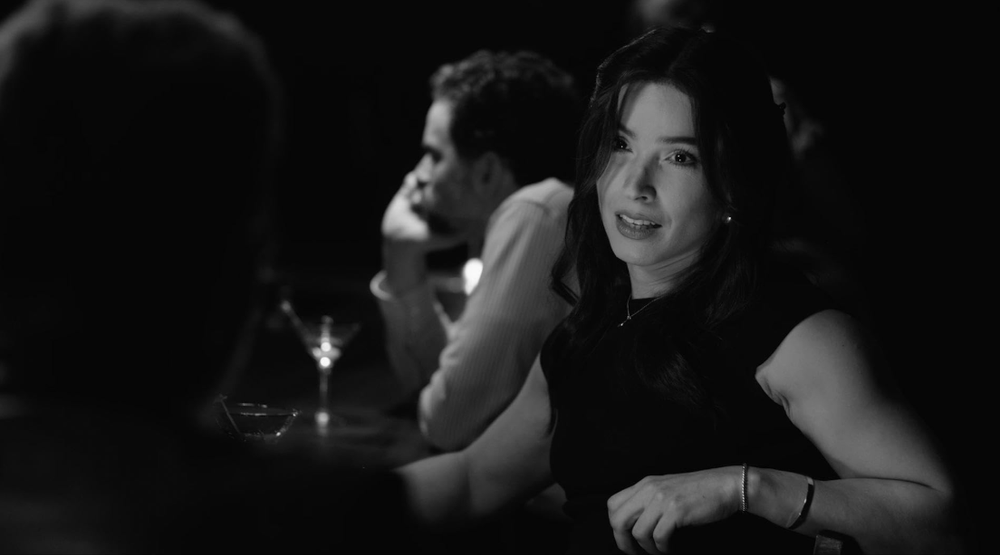
After an opening montage of news clips set to the overused one-hit wonder needle drop of “Spirit in the Sky” by Norman Greenbaum blends the highs and lows of dancing Presidents, destructive protests, and random messianic imagery, The Plea commences to genuflect in the direction of Sidney Lumet. Bathed in soft black-and-white cinematography by DP Tinx Chan (Starring Jerry as Himself), twelve jurors assemble in a room, scrolling through their phones, pacing idly, and venting frustrations before the devices are collected. They’ve all met, but this is their first chance to deliberate or, better yet, argue, and it starts almost immediately. Their names are their juror numbers rather than what’s written on their IDs.

Even so, the stereotypes and archetypes arrive in a hurry, dominated initially by the quarrelsome middle-aged Juror #1, played by The Plea’s co-director and co-writer Dean Imperial (TV’s Godfather of Harlem). He’s your classic “it’s a free country” asshole who’s already stirring shit and rubbing people the wrong way. Once the bailiff (steady TV actress April Matthis) arrives with shouted calls to simmer down and focus on the judge’s order that this case before them be decided unanimously and according to the law, you wonder how this cornucopia of banalities is ever going to agree anytime soon. 

As that uncomfortable and daunting feeling creeps into place, a sizable truth about this film and the jury-centric movies its following becomes clear when the doors are locked. There’s a two-headed monster for these types of proceedings: figuring out the case or figuring out the people voting on the ruling. The Plea, as it presents its path of scenes, tips its hand as to its preferred answer to that proverbial question.

LESSON #1: THE PARTICULARS OF THE CASE AT HAND— Start with The Plea’s case. An unseen defendant, an IVF technician at a fertility clinic, is being tried for twelve counts of murder for spilling a tray of a dozen fertilized embryos that ceased to be viable. Even if the jury considers this act an accident, manslaughter charges are still possible. At the heart of the case is the interpretation of the embryos, technically called EUPs (extra-uterine persons), and the legal definition of “personhood.” The voting divide among the sequestered greatly mirrors the contentious gulf between conservative pro-life defenders and those more staunchly pro-choice. 

LESSON #2: FIGURING OUT THE PEOPLE— Because of the temperature of those topics, The Plea leans on figuring out the people. The most vocal not-guilty/non-personhood proponent is Juror #7 (Antoinette Crowe-Legacy of Passing), a pushy woman willing to stand, shout, and curse to show her dominance on this issue. Her common opponent is her neighboring Juror #8 (Stir of Echoes star Kathryn Erbe), an older, calm woman who sums up all decisions as “God’s will.” Caught in the middle is everyone else—including the sullen widower, Juror #12 (Dennis Boutsikaris of *batteries not included and Better Call Saul), the panic-attack-prone Juror #5 (Trieu Tran of Altered Carbon), the deaf young lady, Juror #6 (Millicent Simmonds of the A Quiet Place series, this movie’s biggest casting get), and the movie star within their midst, Juror #2 (Outer Banks’s Jason Alan Carvell)---and the gay jury foreman, Juror #10, played by the other co-director/co-writer and editor Zach LeBeau, trying in vain to keep the peace. Curiously, to a degree, yet matching Lesson #2’s course of action, more than half of The Plea follows these people outside of the deliberation room. 

Coyly paired in hotel rooms (like the ardent Christian with the incensed Gen-Z atheist and the gay guy with the misogynist) and allowed to congregate at the baobab tree that is the hotel bar manned by the lone bartender (The Wire’s Gbenga Akinnagbe) after each complete day, the ensemble lets their characters’ hair down in these unlocked moments. The assigned quota of liquid courage bends moral judgments, ignites more politics, blurs boundaries, and closes generation gaps in a host of interesting and telling conversations and encounters that become the pinnacle moments of the collected performances. This large group of actors is given wonderful latitude to extract unique depth from their assigned tropes and lanes. Two headturners from this downtime are the aggressive flirts of Juror #2 (Danny DeFerrari of Oppenheimer) and Juror #9 (Starlit Diner’s Carolina Gutierrez), who also hold the position as The Plea’s second loudest and meanest of their gender in the room, after Juror #1 and Juror #7.

Without a doubt, this hypothetical premise in The Plea is a fascinating clash of ideals, even before considering the particular people weighing the verdict. The pendulum swaying between the debate of what constitutes being alive is as precarious as the wavering strength of sacredness towards jury duty itself, and all the buzzwords, labels, and derogatory terms are lashed. Their first vote is 7 to 5 in favor of guilty/personhood, showing they have a long way to go. Add in the chasm represented by wildly different measures of reasonable doubt, and The Plea can press more hot-button talking points than Buddy the Elf hitting floor numbers in an Empire State Building elevator. 

The Plea labels itself as a “comedy noir” within the courtroom subgenre, though, other than a few witty retorts and comeback burns, there are very few laughs. Sure, the bailiff comes in loud, and the scope of this fictional case is grandiose, which can create rub-your-nose-in-it satire between the altruistic and the merciful. However, other than one character briefly acknowledging the unshown media circus out the window, Zach LeBeau, Dean Imperial, and the third contributing writer, Scott Organ (What Comes Around), keep everything on the tremors of group dynamics rumbling one step further than the usual behind-the-scenes setting of a jury room. There’s shrewd wisdom in that call, because, like this film’s second lesson, that’s plenty and that’s where the real intrigue is. While the overarching rhetoric is scintillating and probably deserves more time in actual deliberations, The Plea found the right territory to explore in this all-hands-on-deck indie standout.

Screenshot 2026-10-13 225622.png
Screenshot 2026-10-13 225559.png
Screenshot 2026-10-13 225530.png
Screenshot 2026-10-13 225506.png
Screenshot 2026-10-13 225428.png

LOGO DESIGNED BY MEENTS ILLUSTRATED (#1438)

Permalink


from Review Blog https://ift.tt/coRt8aT

Share:

London Film Festival 2026 – Wildwood ★★★★★

Released: 23 October 2026 Director: Travis Knight Starring: Peyton Elizabeth Lee, Jacob Tremblay, Carey Mulligan, Mahershala Ali, Awkwafina, Angela Bassett, Jake Johnson, Charlie Day, Jemaine Clement, Tom Waits, Maya Erskine, Tantoo Cardinal, Richard E. Grant, Len Cariou, Blythe Danner, Rob Delaney & Arthur Knight Every year, we get one animated feature that pushes the boundaries […]

The post London Film Festival 2026 – Wildwood ★★★★★ appeared first on Movie Marker.


from Movie Marker https://ift.tt/6MrXEf0
Share:

MOVIE REVIEW: Love of Your Life

Images courtesy of Amazon/MGM Studios and Amazon Prime Content Services.

LOVE OF YOUR LIFE— 4 STARS

LESSON #1: SUBTLE TITLING— The title of director Rachel Morrison’s new romantic drama, Love of Your Life, debuting on Amazon Prime, subtly announces the film’s central theme through two of the simplest grammatical nuances. Not beginning with a declarative “The” suggests people, under any number of circumstances, may experience more than one impactful chapter of romance in their lives. Even more delicately, there’s the use of the second-person possessive determiner “Your” instead of the first-person adjective “My.” That could imply the amount of adoration being experienced may not completely feel like one’s own. Label that a serious prophecy hidden right in the title. 

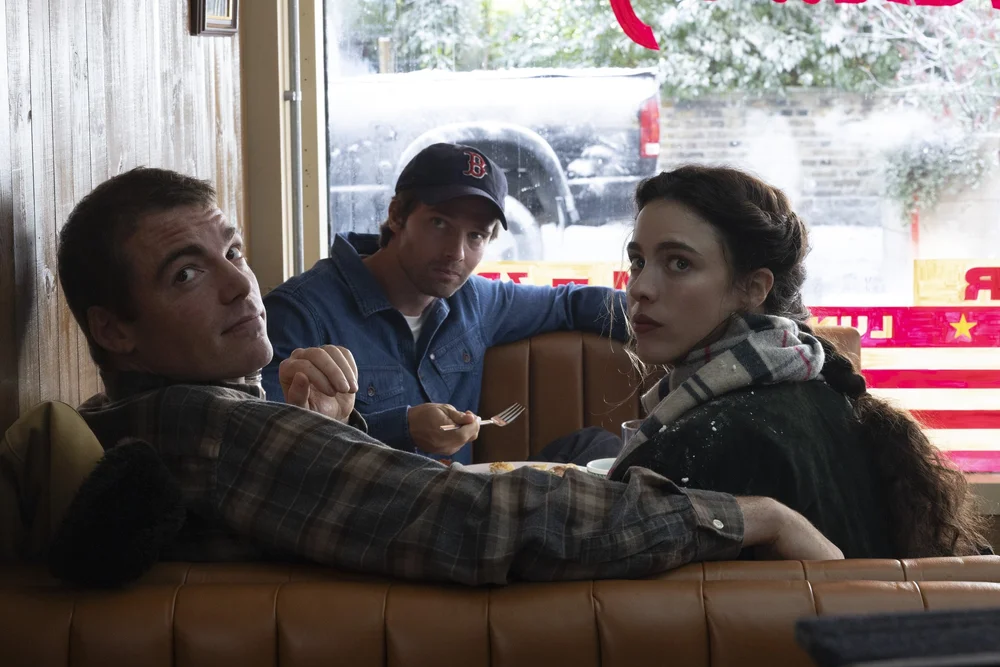
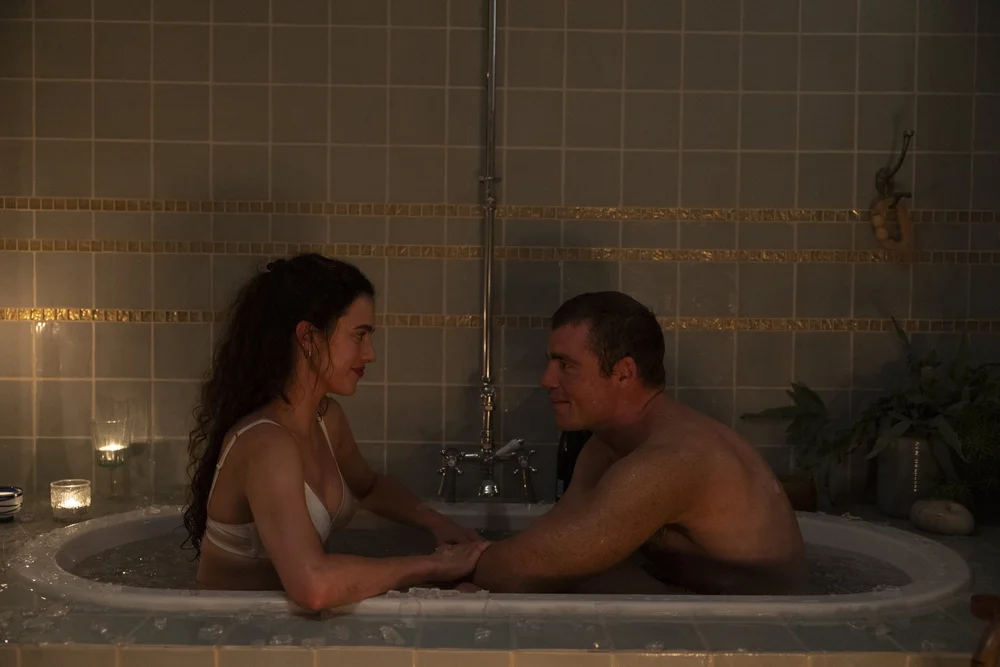
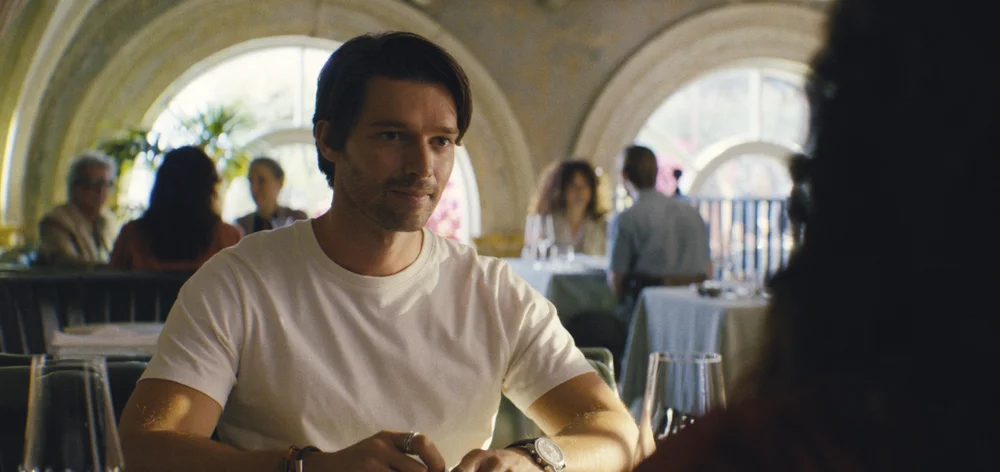
Love of Your Life begins with a “Meet-Cute” between a 26-year-old hospital nurse named Maya (The Substance’s Margaret Qualley) and the Ph.D. student, Charlie (Gabriel Basso of Hillbilly Elegy), who is selling her an old nightstand for refurbishment via Facebook Marketplace. Immediately smitten, he asks her out on a date, and she obliges, beginning a lovely and spirited courtship of exploring interests and being each other’s decompression partners from their professions. Time-hopping to the next year in labeled chapters matching Maya’s age, the two have become a cohabiting long-term relationship, joined by a shared bestie named Jason (Patrick Schwarzenegger of TV’s The White Lotus) always along for the youthful adventures and supportive encouragement.

LESSON #2: BRINGING FAMILY TO A FAMILY-LESS PERSON— In their second year together, Charlie and Maya discover a key difference in confidence between them as they approach the topic of marriage and becoming parents someday. Charlie grew up as the adopted son of a stable Cape Cod family (headed by the wonderful Catherine Keener and current Digger ensemble member Corey Johnson), whereas Maya is the product of a one-night stand who has and holds no family attachments. With that lack of history or upbringing and matching that opening lede of “your” versus “my,” Maya never feels fully comfortable around Charlie’s family. Attaching her personal journey to another’s often feels unnatural, borrowed, or out of place. While her character comes to welcome the chance to join a legitimate family, Qualley plays this existence with tremendous apprehension.

Nevertheless, the lovebirds pull off a surprise wedding in their apartment during a monsoon storm that has family and friends sweating from the power outage and partying with candles lit. While this could all fit in the present day, Love of Your Life, through a glance of the couple watching a TV news story, announces that this 27th year of Maya’s is 2020 and the onset of the COVID-19 pandemic, changing the entire gravity of the setting. Charlie is an immunocompromised asthmatic, and Maya gets it the worst as an overwhelmed nurse. When a crushing tragedy suddenly strikes, the screenplay of Julia Cox (Nyad) leaps to “thirty-one,” revealing a drastically changed Maya—traveling in Portugal, smoking cigarettes, and working remotely with telehealth clients. 

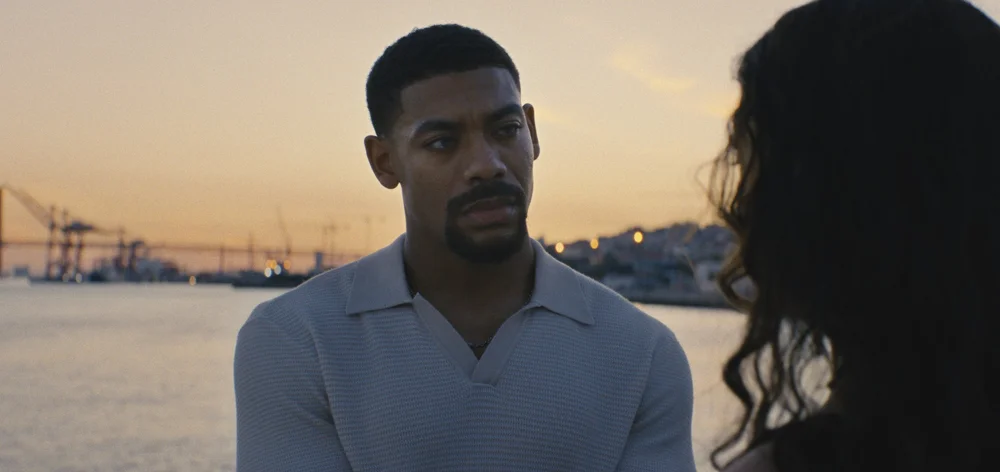
LESSON #3: FLEEING GRIEF— The jump in time shows Maya with all the behaviors of a person fleeing grief. She has withdrawn from previous material and personal attachments. Emotional numbness has her drifting through drunken stupors and one-night stands. It may look like what one soon-to-be important presence—a new traveling British suitor named Felix, and played by red-hot Lanterns star Aaron Pierre—will call “solitary hedonism,” but it’s a destructive course of failing self-care after several layers of trauma. This inability of Maya to grieve and create stable connections with new and established people becomes the weight of Love of Your Life.

LESSON #4: SEARCHING FOR THE RIGHT THING TO SAY—In a thicker script, Love of Your Life would be filled with stump speeches and one-sided monologues that pour emotions out by the bucketful. Instead, the shared sentiments struggle as much as the psyche. Morrison’s film is relatably filled with a collection of blemished characters so desperately searching for the right thing to say because, in many instances, there are no perfect words that fit, heal, or propel the difficult moments folks are going through. That’s not an imperfection of a weak dialogue, but rather the reality of the given situations at hand. The challenges, even with their grimness, feel tangible and appropriate to the drama. Nevertheless, bring the tissues.

Heavily established by her edgy resume in other genres, Love of Your Life is Margaret Qualley proving romance is within her acting arsenal as a rising star. Every actor worth their salt should put a movie like this on their resume to show their range. Qualley’s performance is shaped by a wringer of hopeful happiness, stubborn mistakes, worrisome terror, and fragile remorse. Her balance act of resolve elevates this walkabout journey higher than the typical, inescapable feeling-sorry-for-herself doldrums we’ve seen before in movies about mourning. Also, other than the scourge of COVID and Maya’s self-destructive habits, this is, pleasantly, a villain-less picture boosted by its luscious travelogue jaunts of location shooting and two alluring beaus in Gabriel Basso and Aaron Pierre, who bring entirely different levels of appeal to our leading woman.

Love of Your Life proves that there’s always room for a good weeper at the movies. We, as the audience, attach ourselves to figures we love quickly, and process the acceleration of missing them when they are taken away. Watching fictional proxies go through recognizable pain can help viewers reflect, consider, prepare, or push through their own, in classic “what would you do?” fashion. Maybe we’re the type to stay and not run away like Maya, but a good crusher with sweep like Love of Your Life reminds you of what you have and what is possible. As Felix chooses to remember, “This was something.”

LOYL USA TODAY_rgb.jpg
LOYL_2026_UT_250828_JAMCHI_03492_rgb.jpg
LOYL_2026_UT_250902_JAMCHI_04373_rgb.jpg
LOYL_2026_UT_251006_JAMCHI_13650_1_rgb.jpg
loyl_r709_01.07.18.03_1.88.1_1_rgb.jpg
loyl_r709_01.10.07.13_4.11.1_rgb.jpg
loyl_r709_02014111_1171_rgb.jpg
loyl_r709_03104709_1103.1_rgb.jpg
loyl_r709_05084118_1721_rgb.jpg
loyl_r709_05181808_3182_rgb.jpg

LOGO DESIGNED BY MEENTS ILLUSTRATED (#1437)

Permalink


from Review Blog https://ift.tt/HLF71IM

Share:

Blog Archive

Recent Posts

Unordered List

  • Lorem ipsum dolor sit amet, consectetuer adipiscing elit.
  • Aliquam tincidunt mauris eu risus.
  • Vestibulum auctor dapibus neque.

Sample Text

Lorem ipsum dolor sit amet, consectetur adipisicing elit, sed do eiusmod tempor incididunt ut labore et dolore magna aliqua.

Ut enim ad minim veniam, quis nostrud exercitation test link ullamco laboris nisi ut aliquip ex ea commodo consequat.

Theme Support

Need our help to upload or customize this blogger template? Contact me with details about the theme customization you need.