


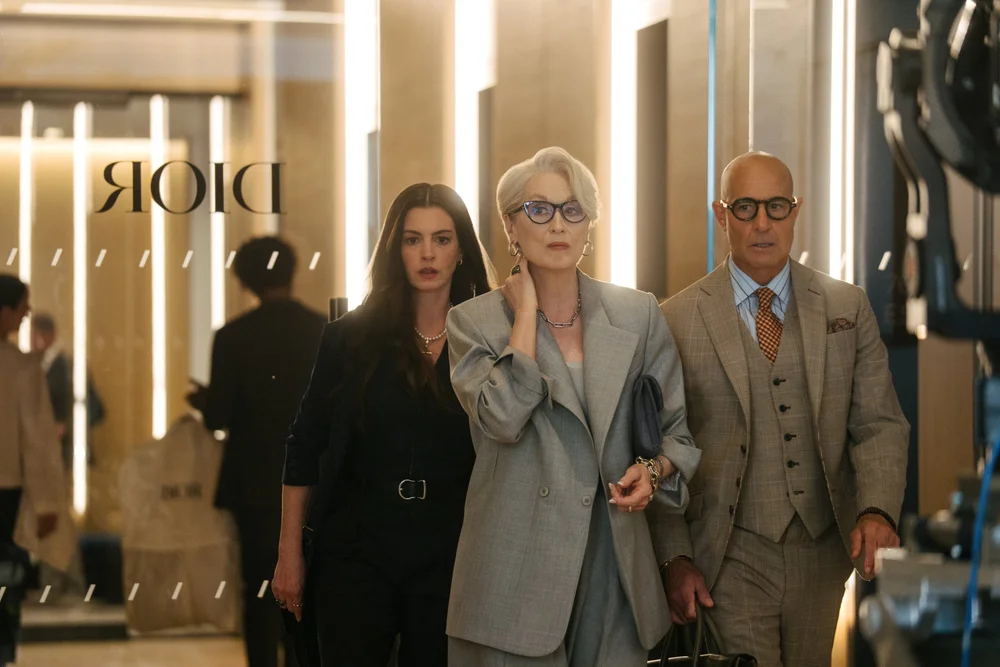
Image courtesy of Walt Disney Studios
The Devil Wears Prada 2 arrived in theaters on May 1 carrying twenty years of accumulated nostalgia. Audiences came back for Meryl Streep’s Miranda Priestly, the ice-blooded editrix of Runway magazine, and for the fantasy of a glossy Manhattan media world where the right job could change a young woman’s self-definition and maybe her life.
What they got was something closer to a eulogy. The sequel’s plot turns on the decline of Miranda’s magazine, and critics noticed immediately. The Hollywood Reporter observed that the film “…knows the media is melting down.” The New Statesman went further, reading the movie as a chronicle of the death of the women’s magazine itself.
John Chachas thinks the filmmakers got it mostly right, though missed the villain.
“It’s about one thing: the destruction of Miranda Priestly’s magazine,” he says. “That’s not wrong.”
John Chachas’ career puts him in a position to grade Hollywood’s homework. As founder of the boutique investment bank Methuselah Advisors and former co-head of Lazard’s media advisory practice in the Americas, he spent more than three decades structuring deals that defined modern American media, including the $18 billion buyout of Clear Channel Communications and Disney’s 2006 sale of ABC Radio and the sale of Rolling Stone magazine and US Weekly, among others. He has spent his career valuing media companies and giving advice to executives and owners. Which means he has spent the last twenty years watching those values erode.
The Twenty Years Between Films
The first Devil Wears Prada premiered in 2006. Condé Nast, the real-world inspiration for the film’s publishing empire, was then at the height of its powers, a company so flush that its town cars and expense accounts were the stuff of industry legend. People magazine and Sports Illustrated were extraordinary franchises printing money.
The sequel arrives in a different world. Two decades later, the consumer titles are unrecognizable if you can find a print copy. And Anna Wintour is gone from Vogue living at her Met Ball as her next act.
“In the twenty years from when they made the first movie to this movie, Condé Nast and the Hearst, the two largest owners of consumer magazines, have both radically different businesses,” John Chachas says. “Their print products have been severely erode in terms of their value and profitability. The digital transition has not been kind despite exceptional efforts at both companies.”
The record supports him. Condé Nast has cycled through repeated rounds of layoffs, with cuts landing in December 2024, March 2025, and May 2025. Pitchfork was folded into GQ. Self was shuttered. Glamour ended its regular print edition in 2018, Allure in 2022. In late 2025, the company collapsed Teen Vogue into Vogue’s website and laid off most of its staff. Across the industry, U.S. magazine advertising revenue has fallen from roughly $10 billion in 2017 to about $4.3 billion in 2025.
“To be clear there sure some exceptional titles surviving this profound digital transition, but a long list of print titles are just gone — Meredith, Time Inc., Forbes, Hearst, Conde it has impacted everyone.”
There is a moment of dark comedy in how the real Vogue handled the film’s release: Meryl Streep appeared in character as Miranda Priestly on the cover of the April issue, a fictional editor drafted to sell a real magazine. Slate noted the irony. The most powerful fashion title on earth was borrowing relevance from a movie about its own obvious decline.
Where the Money Went
The fashionable explanation for the magazine industry’s fall is cultural. Readers moved on. Influencers replaced editors. Print became a luxury affectation.
John Chachas, who has spent his career reading balance sheets rather than runway shows, offers a colder diagnosis. The money did not evaporate. It moved, and it moved to a very small number of addresses.
“If you added up all of the revenue from television broadcasting, cable systems, cable networks, magazines, and newspapers, their entire industries, they are a tiny fraction of the money being generated by one of Meta, Amazon, or Google,” he says.
The math is not close. In 2025, Google generated roughly $214 billion in advertising revenue and Meta roughly $196 billion, with Amazon’s ad business adding nearly $69 billion more. Combined, that is approaching $480 billion. Set against it: about $10 billion for U.S. newspaper advertising, $4.3 billion for magazines, and roughly $56 billion for traditional television. Three companies now collect almost seven times the ad revenue of the entire American newspaper, magazine, and broadcast TV businesses put together.
Radio, the industry where Chachas advised on numerous large transactions, tells the same story in miniature. The major radio groups that commanded premium valuations in the 2000s have been through bankruptcy restructurings, and the business has shrunk to a shadow of the industry that once justified an $18 billion buyout. American workers not driving to work any longer (post Covid) has had a direct impact on drive-time radio audiences.
“The destruction that they have brought on so many parts of American media has not yet seen its reckoning,” Chachas says of the platforms. “And government hasn’t done a thing about it. Indeed, Government seems to like the power in the hands of these very few digital giants.”
The Reckoning That Never Came
That last point is where Chachas departs from most media commentary. The decline of magazines is usually narrated as inevitability, the natural churn of technology replacing what came before. Chachas, who watched regulators shape every industry he ever worked in, sees a policy failure.
“In the 1950s and ’60s, the steel industry, the oil industry, the airline industry, nobody was allowed to have that kind of power and not be reined in by the FCC or the Justice Department,” he says. The platforms that absorbed legacy media’s revenue, in his view, were allowed to amass a concentration of economic power that no previous generation of regulators would have tolerated. The advertising dollars that once funded fact-checkers, photo desks, and foreign bureaus now fund server farms, and no one in Washington ever forced the question of whether that exchange served the public.
He is not sentimental about what was lost, exactly. Magazines were businesses, and businesses fail. His concern is what the collapse removed from the culture. Publications like Vogue and its rivals were, for a century, the documenters and filters of American taste. That role has been atomized into a million feeds, each curated by an algorithm whose only editorial standard is engagement. Newspaper companies fielded reporters to cover laws generated in state houses, and today since the news business has no economic model, there is no coverage of what state legislatures are doing. And is Google or Meta replacing that coverage? Obviously not, so the loss is real and not replaced by any substitute – print or digital.
The Devil Wears Prada 2 understands this, which is what makes it a sharper piece of media criticism than most of what runs in the trades. The first film asked whether a serious young woman should want Miranda Priestly’s drive and the spoils of her world. The sequel asks what happens when that world simply stops existing, and nobody in power thinks it is their job to care.
Chachas has his answer. The movie, to its credit, has the honesty to ask the question.
from Review Blog https://ift.tt/Pey1Jun


No comments:
Post a Comment