• This is default featured slide 1 title

    Go to Blogger edit html and find these sentences.Now replace these sentences with your own descriptions.This theme is Bloggerized by NewBloggerThemes.com.

  • This is default featured slide 2 title

    Go to Blogger edit html and find these sentences.Now replace these sentences with your own descriptions.This theme is Bloggerized by NewBloggerThemes.com.

  • This is default featured slide 3 title

    Go to Blogger edit html and find these sentences.Now replace these sentences with your own descriptions.This theme is Bloggerized by NewBloggerThemes.com.

  • This is default featured slide 4 title

    Go to Blogger edit html and find these sentences.Now replace these sentences with your own descriptions.This theme is Bloggerized by NewBloggerThemes.com.

  • This is default featured slide 5 title

    Go to Blogger edit html and find these sentences.Now replace these sentences with your own descriptions.This theme is Bloggerized by NewBloggerThemes.com.

MOVIE REVIEW: Nope

Image courtesy of Universal Pictures

NOPE– 3 STARS

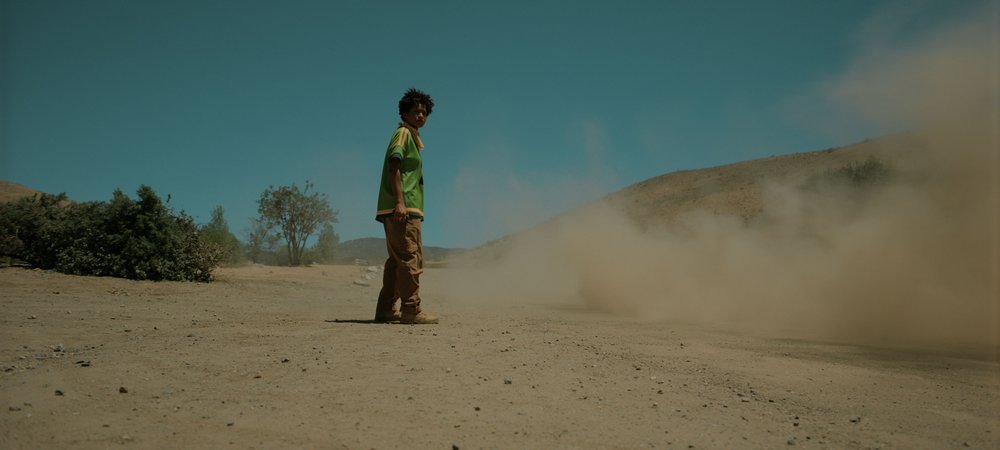
As admittedly peculiar as it is to say, the most dependable places of comprehension and safety, as it were, for a viewer to latch onto in Jordan Peele’s Nope are the horses. Yes, of all places, the hooved colts and mares with no dialogue offer you the straightest reads of every alarming moment and situation in this film. Now, what that says comparatively about the humans, predicaments, and otherworldly elements working beside them is an entirely different thing.

LESSON #1: THE INTUITION OF HORSES– With the tangent-spinning risk of having this film review, right out of the gate, sound like it is channeling 1998 Robert Redford or being published by Horse and Hound magazine, much to the joking delight of the Notting Hill fans out there, please know this appreciation and observation has its proven validity, even when applied to a twisted science fiction thriller. Horses are among the most in tune animals in the world when it comes to sensory processing and sensory awareness. They unquestionably rely on their instincts at the physical, mental, and emotional levels in assessing life and death situations. 

To put it more casually and in a way fitting the movie, horses say “nope” with fight-or-flight responses faster than and far before us humans. When Nope pushes your buttons and raises your pulse rate, follow what the horses do and you’ll fare well. Alas, we know humans behave differently and so does Jordan Peele. He knows man’s curiosity, perceived dominance, and other courage-warping temptations bend people to test survivability beyond their instinctual triggers until their own exit point or fatal failure. 

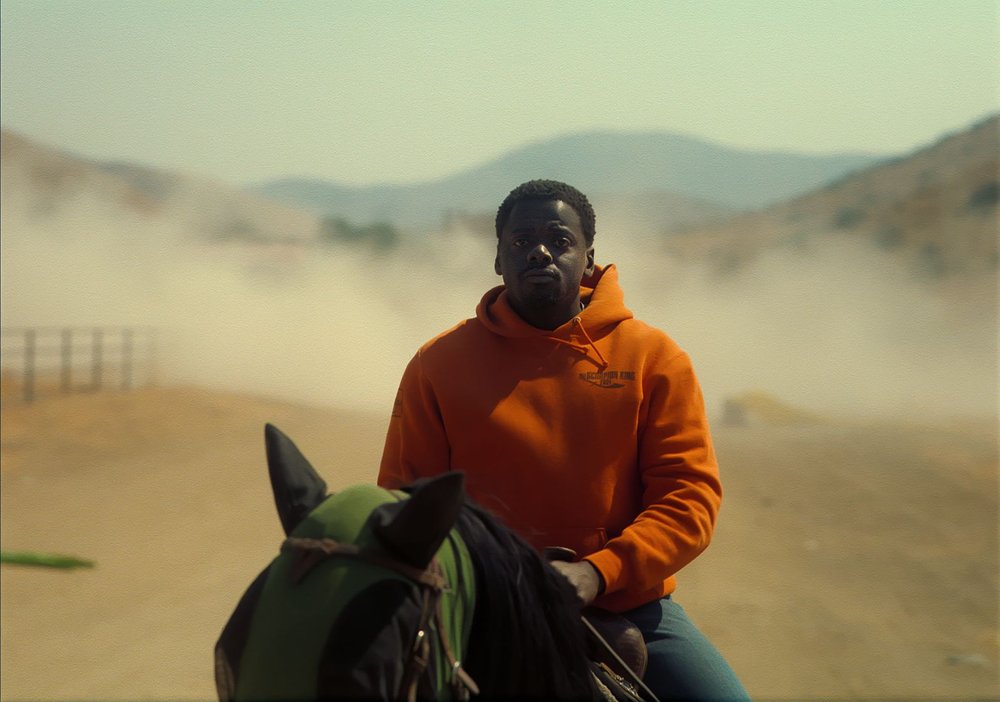
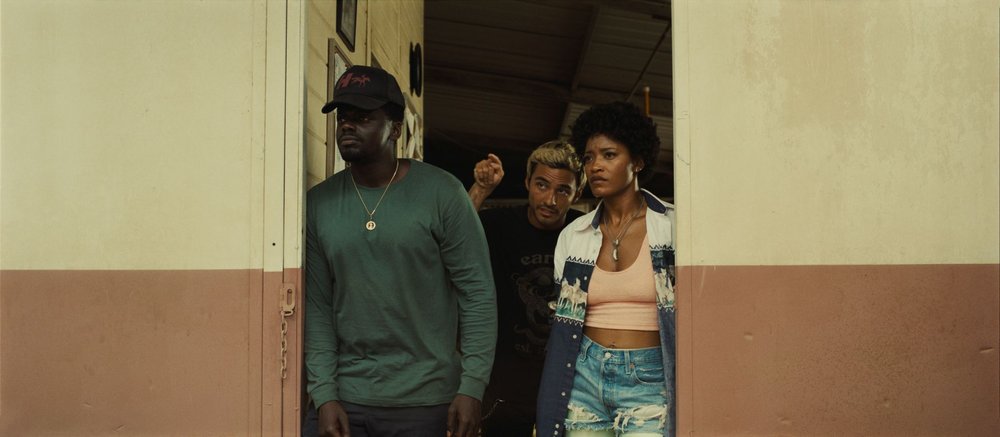
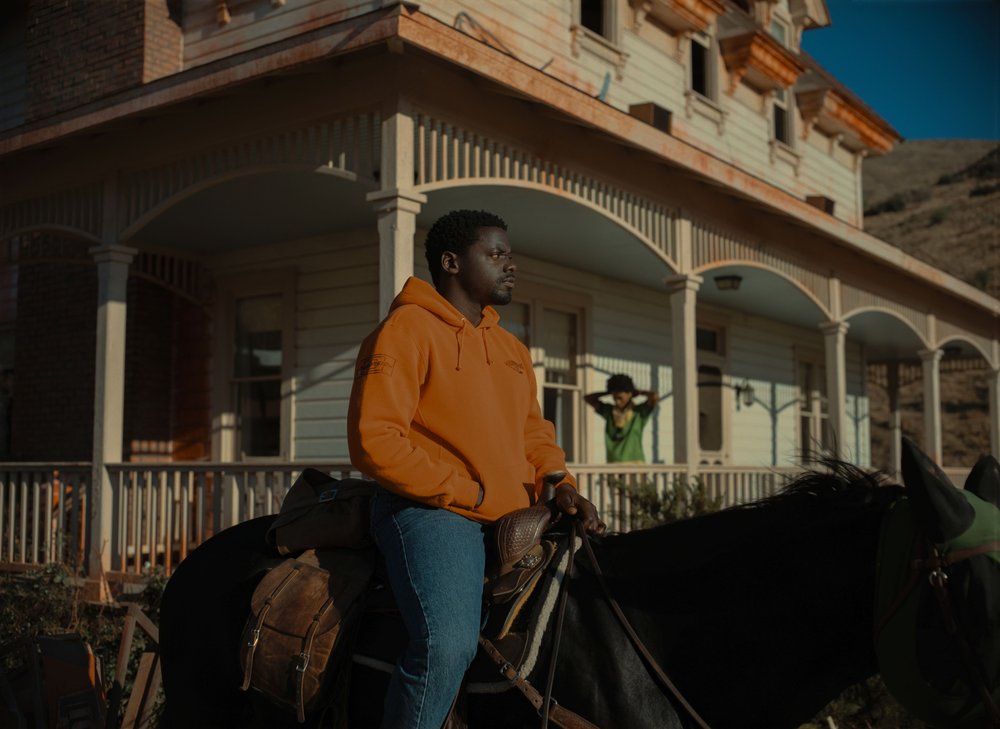
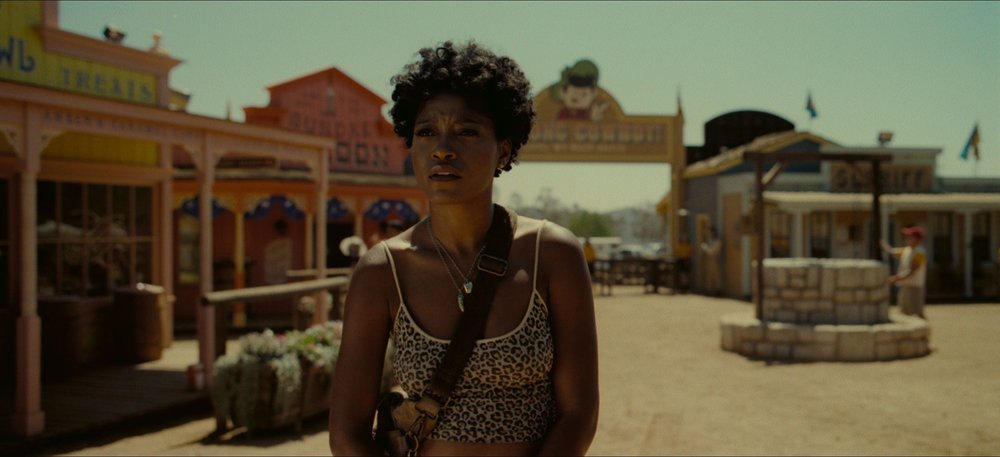
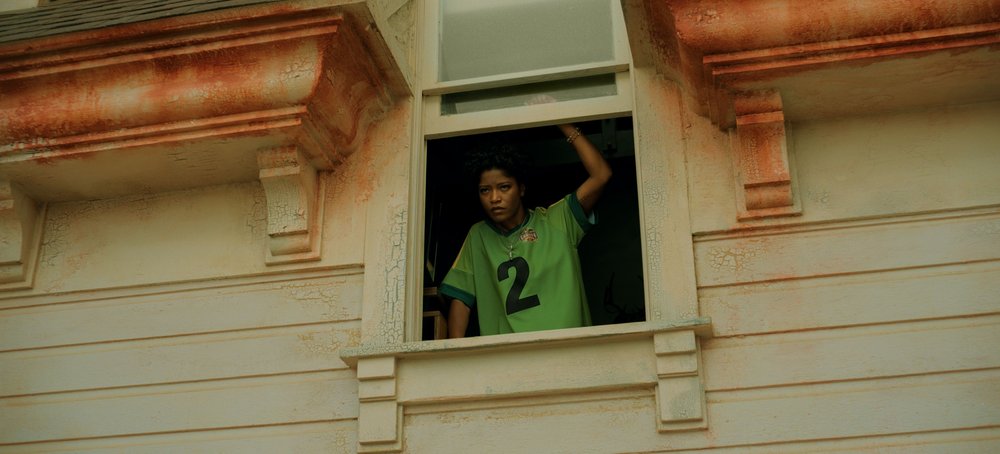
Working damn hard to disprove the old Hollywood adage of “never working with children or animals,” Jordan Peele lets those horses be the first and strongest vessel of many put through the survival wringer of Nope. With an ancestral homage to the black jockey of Eadweard Muybridge’s “Animal Locomotion” early film experiments of the 1880s, the brother and sister team of OJ Haywood (Academy Award winner Daniel Kaluuya) and Emerald Haywood (recent Alice star Keke Palmer) work as show business animal wranglers specializing in horses. He’s the introverted farmhand and she’s the talkative and unfiltered face of the operation bequeathed to them by their deceased father Otis Sr. (the golden-throated Keith David). 

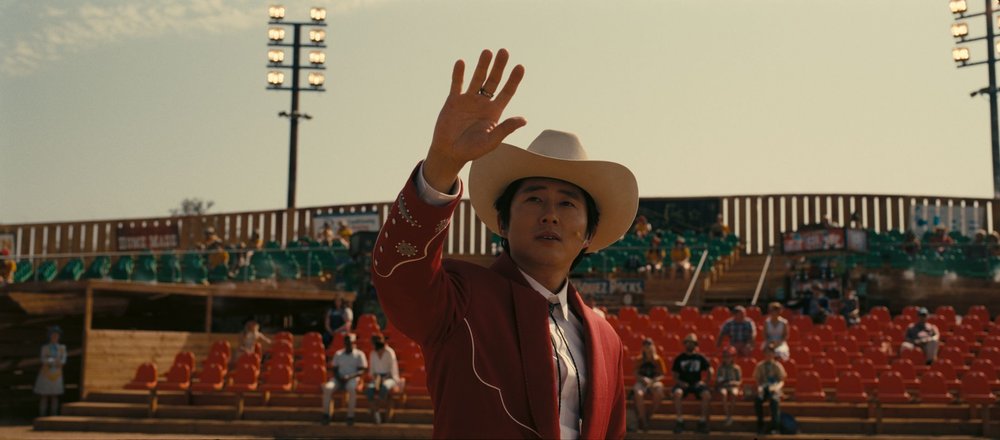
The homebase of Haywood’s Hollywood Horses is located outside of Aqua Dulce in southern California. The ranch’s nearest neighbor is the “Jupiter’s Claim” western-themed entertainment park run by grown-up child actor Ricky Park (Minari Oscar nominee Steven Yeun) and his wife. His dubious shingle of fame is being the survivor of a horrific on-set incident where a trained sitcom chimpanzee turned on his cast and handlers. He feigns having lucrative happiness and closure, but the trauma has never gone away. 

Speaking of tragedy, six months prior to the present time of Nope, Otis Sr. was killed atop his steed by deadly debris inexplicably falling from the sky. Nothing in Aqua Dulce has been the same since as OJ and his horses, and soon Emerald and their newfound techy friend Angel (The OA’s Brandon Perea), begin to witness and encounter unexplained sounds and flying phenomena emanating from a cloud on the horizon that never seems to move with the rest of the weather. The prevailing hypothesis is, naturally, aliens. Cue the Dramatic Chipmunk!

LESSON #2: THE REASONS WHY ALIENS WOULD COME TO THIS PLANET– That infusion of science fiction cements a threatening and interesting premise for Jordan Peele. The first two-thirds of Nope sinks into it deeper and deeper to evoke both comedy and horror at any given moment, two specialties of the Get Out and Us Oscar winner. Hilariously according to Angel, there are only three reasons why all aliens would come to Earth: 1) To seek peace, 2) It’s our future selves going back in time to prevent destruction, and 3) The world killer variety. That’s a sound list, and those possibilities prod which characters cower in fear and which are drawn to the danger.

LESSON #3: REACHING YOUR REFUSAL AND EXIT POINT– This escalation of frazzle and nerves also typifies the title of the picture. What a word! Go ahead and count how many times “nope” is dropped when something wholly and wild happens or when a peer asks another if they’re doing good. We, the audience, borrow that word ourselves to select which points we would be packing up and running for the hills out of Aqua Dulce. At the same time, viewers get to extrapolate how many horrific events could have been stopped or prevented by the uttering of and subsequent follow-through of action sprung by that quick word of refusal and exit.

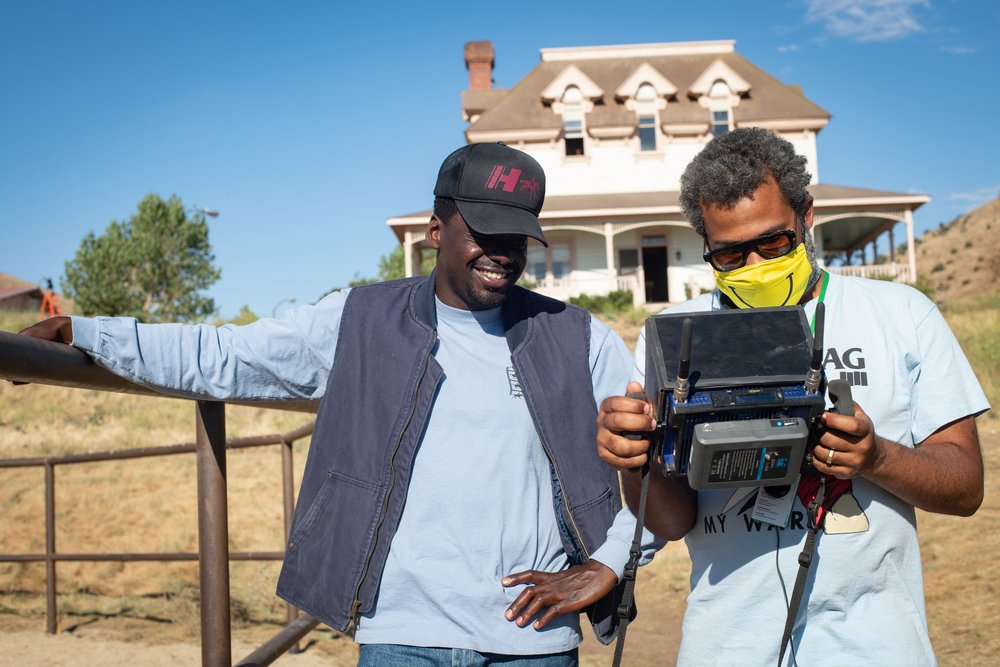
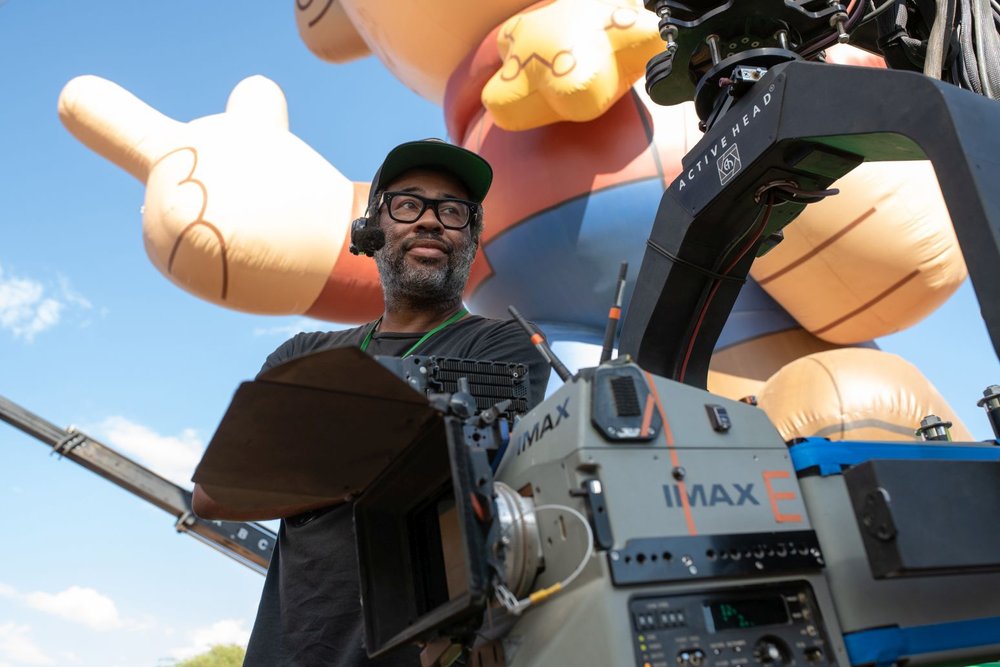
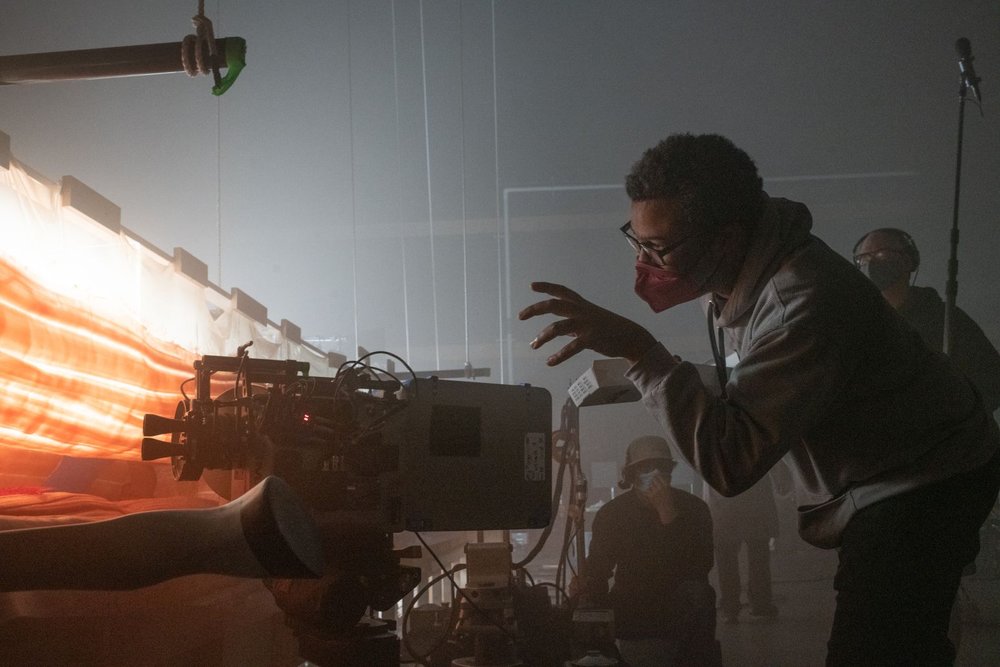
Every time whatever is in that cloud comes near, the electrical power drops creating silence and darkness. Employing crack sound design work that booms in the IMAX format, these moments of mood change amplify the shrill symphony of terrifying noises that announce the presence of the unseen force of nature from above. True to Jordan Peele’s talent for suspense, Nope has many thrilling sequences brightened in some moments to shock us and shrouded in others to rattle our cages. The artistic engines for that anxious ambiance are ace cinematographer Hoyte Van Hotema (Tenet, Interstellar) and Peele’s trusty regular composer Michael Abels, both doing stellar work. 

This high-wire act of fierce endurance has become Peele’s personalized playground for three feature films after making the jump from comedy television. Within his niche landscape, Peele is also one of the most exotic cinematic horticulturists, so to speak, we’ve ever seen. Few storytellers plant suggestive seeds of messaging and symbolism as sturdy or as deep as he does in his films. The challenges with his films, in that regard, have been the attention paid to which seeds and the eventual consequences of their outcomes.

Let’s start with the attention factor. That half of the difficulty rears an ugly head in Nope, and one that is getting scratched far more often than it should. From an intimidating opening Bible verse scourging the filth and vileness of man to the self-important chapter cards given to the names of OJ’s horses, there are cues and clues to be had everywhere in this film. Granted, that’s a credit to screenplay detail from Peele and the application of those elements through the production design of Ruth De Jong (Manchester By the Sea), the props from veteran TV property master Michael Glynn, and the striking visual effects of Guillaume Rocheron (Ad Astra). Even a single blood-splattered child’s shoe that can inexplicably stand on its toe cap elicits head-tilted dazzlement that gets the juices flowing.

However, Peele piles on the screenplay fertilizer for some seeds while leaving others barren with the California desert. Avoiding spoilers, the characters or anecdotes in Nope given the most dedicated caretaking end up being unimportant, causing the overall effort to be questioned. Look no further than the rich character history given to Steven Yeun’s sideshow Ricky Park versus the lack of growth or change awarded to Daniel Kuluuya and Keke Palmer’s main characters who dominate the screen time. No offense to the Judas and the Black Messiah Oscar winner or the former Akeelah and the Bee breakout, but maybe should have been Yeun’s movie.

That said, the overall goal has to be compelling by the end of all the mystery. With all that is packed into Nope, the grand sum is little more than a band of citizens trying to get a single shred of video or photographic proof of alien existence for a tabloid cash-in. That kind of chosen outcome feels too slight when coming from all the foreboding ominousness it took to get there.

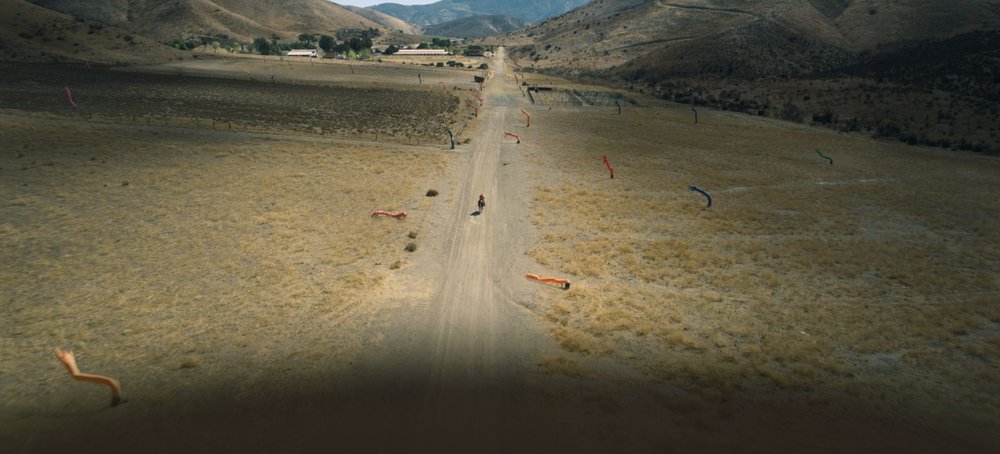
From there, the entirety of Nope adds up to a sometimes wobbly balance of consequential and inconsequential outcomes because of those suspiciously selective and disproportionate points of focus. Peele was rightly coy and wise to scatter so much misdirection and symbolism overload. Investing an audience in fleshing out their own discovery is a welcome exercise if the culmination can justify the journey. In a frequently exquisite and stylized fashion, right down to the herky-jerky tube men imagery, Nope toes the line of keeping viewers entertained in the dark without making them feel too stupid.
NOPE
N3.jpg
N4.jpg
NOPE
NOPE
Nope
N8.jpg
N9.jpg
NOPE
N11.jpg

LOGO DESIGNED BY MEENTS ILLUSTRATED (#1056)

Permalink


from Review Blog https://ift.tt/VB5eR3X
Share:

Who Is Considered The Best James Bond Ever?

The James Bond franchise is the longest-running of all movie franchises in history, with an awe-inspiring 25 films released. With such longevity, seven actors have played the iconic character to date. There is much speculation about who the next Bond will be played by, but that is a question the studio is not keen to […]

The post Who Is Considered The Best James Bond Ever? appeared first on Movie Marker.


from Movie Marker https://ift.tt/lr8wUuC
Share:

MOVIE REVIEW: Alone Together

Image courtesy of Vertical Entertainment

ALONE TOGETHER– 3 STARS

Establishing a very pleasing attitude in the opening credits hopping through Manhattan, writer-director Katie Holmes uses a willowy cover of the Great American Songbook staple “Blue Moon.” When applied to the restrictive hurdles created by the film’s early pandemic setting, its familiar lyrics go from cordial and delicate to expressive and meaningful. If you know the song, it starts here:

Blue moon

You saw me standing alone

Without a dream in my heart

Without a love of my own

As the ballad continues, prayers are answered, a passionate prospect arrives, and adoring love wins over our lonely and lost singer. It converts the “You saw me standing alone” verse into “Now I’m no longer alone.” Our voice has found the only comforting arms they will ever need. 

For Alone Together, “Blue Moon” is a lovely tone setter, one that reappears as a connecting point of poignancy later in the film. Lo and behold, to learn in the closing credits that Holmes’ own daughter Suri Cruise sang this chosen cover and that the film is dedicated to her adds to the specialness. Applying a yearning honesty to real-world uncertainty, Alone Together creates as capable and as heartwarming of a romantic renewal as the well-chosen old standard proclaims with thankfulness. 

The celebrated actress calls her own number as June, a magazine food critic in a somewhat stagnant relationship with John (Derek Luke, in his first feature film in seven years after TV success on 13 Reason Why) while living on the Upper West Side. Little bits of diegetic news snippets in the background present the onset of the COVID-19 lockdown that began on the Ides of March in 2020. Flexing her well-heeled means, June has booked an Airbnb getaway for her and John to escape the city and wait out the pandemic. In the collapse of services, she frustratingly meets subway and train stations with complete cancellations.

When a Lyft driver finally does get June out to the idyllic country home she selected, the place is double-booked by the owner. A restoration specialist named Charlie, played by Jim Sturgess of Across the Universe and Cloud Atlas, has already arrived. After the exhausted and entitled June simmers down, Charlie takes pity on her and the state she’s in with no means of transportation. They agree to share the place until things can get sorted out. Sure enough, this conundrum becomes a smudged Meet Cute for two strangers that find they have more commonalities than they realize as they seek to pass the time and stay safe. As the mandated isolation increases the barriers around them, the boundaries between them melt with empathy and affection.

LESSON #1: WHAT DID YOU NEED DURING THE EARLY PANDEMIC?-- Halfway through 2022 and deep into new understandings since COVID-19 first spread, we have reached enough calloused history to look back on the early pandemic and all of its unknowns with decent reflection. Alone Together does have the advantage of 20/20 hindsight, yet frankly portrays the confusion of what we expected to need, and what we didn’t, from the extended period of sheltering. While the masses hoarded hand sanitizer and toilet paper, other folks, including June and Charlie here, sought different material items of comfort and personal measures of stress-reducing safety. We can see now the wins and losses of pragmatism versus superficiality from that initial panic, and the film plays into that kindly without leveling finger-wagging blame.

LESSON #2: WHO NEEDED YOU DURING THE PANDEMIC?-- There’s no “perhaps” here. We entirely know now what we didn’t know then that the biggest pandemic essentials were the loved ones we couldn’t pack in a bag, buy multiples of, or keep with us in our home. We needed our people and, hopefully, there were people who needed us in return. Once the viral dangers increased to the point where families and friends were kept apart to the point of missing births and funerals, the emotional pain became more harmful than the disease’s debilitating symptoms. The ache of those needs will be the lasting memory from this time period, and is the right emotional core for Alone Together.

As we come to learn, John is worried about his aging and high-risk parents. Instead of joining June up north, he retreats to live with them. Likewise, the only family June has left is a grandfather in a senior living facility riddled with late stage Alzheimer’s enough to recognize her anymore. Charlie, with nerves of his own, finds himself out of the city to get away from a recent fizzled relationship and a shuttered business. His one confidante is his chipper and worried mother, played by Oscar winner Melissa Leo, who is also kept from him across the divides of FaceTime and Zoom. 

LESSON #3: SHARED COMPANIONSHIP BREAKS SHARED LONELINESS– On the simple side, Charlie and June bond over McDonald’s, Wild Turkey, bike rides, and in-home karaoke. Yet, it takes the Lyft driver before they even meet to remind June that “good stuff is never easy.” Filling more running time than the fun in Alone Together is the not-so-small talk shared by Charlie and June in this rental property. When the two open up, it’s not all about superfluous details. Their respective heavy challenges, big losses, and realizations of shortened windows of time come forward. The supportive ways they respond to each other prove shared quality time makes all the difference.

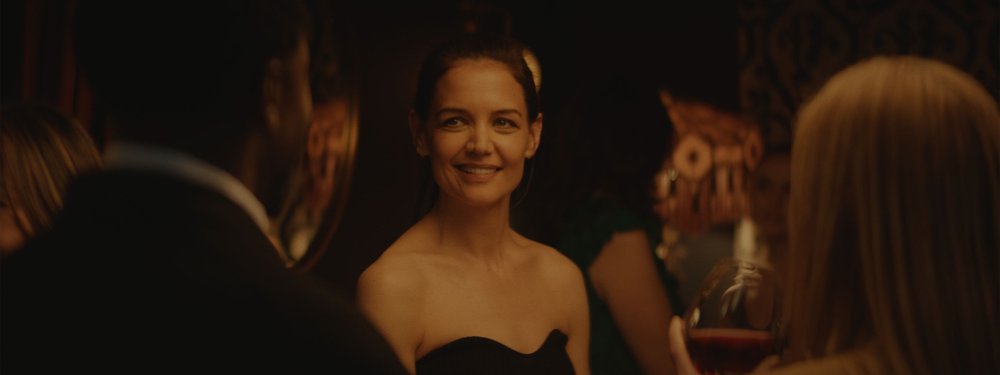
Jim Sturgess employs a breathy ease as Charlie that can soften tension better than any bottle of wine or shoulder massage in the world. As a screenplay creation to be a foil across from June’s initially privileged neuroses, his patient and bearded worldliness probably comes across as too perfect. Combine his attractive appeal with the ageless, disarming smile of Katie Holmes herself, the soft piano score from Graham Reynolds (Where’d You Go, Bernadette), and the serene transition shots captured by cinematographer Martim Vian (Young Hearts) and that feeling of mushy convenience might grow.  

However, Alone Together is no vacuous two-week fling of a love triangle. The thick and relatable flaws given to these characters by Holmes remove some of the gloss and shave down the easiness. Past and current tragedies for these two potential lovers weigh heavily where their togetherness is not automatic for permanence or even healed confidence. For every moment where bliss found in isolation and the gratefulness of good health are momentarily glorified, Holmes’ film reminds us that “if it hurts, it hurts” in that suffering doesn’t always have social or class divides. With that approach, both the central characters and Alone Together earn their fighting chances at finding love amid these faults.

In directing her second feature following 2016’s tepidly-received All We Had, Katie Holmes has shown visible improvement. As a writer, she has struck a very steady and appealing balance between the character-reinforcing pain present and the desire to celebrate the fragile possibilities of love derailed by our pandemic lockdown. The premise of Alone Together may suggest serendipity that is too easy. If this was Nancy Meyers, the threads of this movie would all end in laughs. Instead, the dramatic difficulties fleshed out Holmes and her cast prove otherwise. The direction and storytelling grace of Holmes’ results are very praiseworthy, especially during this continuing pandemic.

AT2.jpg
AT3.jpg
AT4.jpg
AT5.jpg


AT8.jpg

LOGO DESIGNED BY MEENTS ILLUSTRATED (#1055)

Permalink


from Review Blog https://ift.tt/8W9HNy7

Share:

MOVIE REVIEW: My Old School

Image courtesy of Magnolia Pictures

MY OLD SCHOOL– 3 STARS

Maybe it’s a moment played up more in movies and television, but who had a frustrated high school teacher in their day who laid down the challenge of “If you think it’s so easy, would you like to come up and teach the class?” Normally, that’s the adult in the room nearing their wit’s end with a certain overconfident or mouthy student. In your experiences, did that challenge work to shut down the distraction? Did anyone ever have the balls to actually do it? Did any succeed?

Though this may be an odd parallel to make, but after watching the documentary My Old School, I’m willing to bet the chronicled subject, Brian MacKinnon, better known as “Brandon Lee” while attending Scotland’s Bearsden Academy, could have pulled that ruse off and taken over a classroom. After all, the man was already masquerading as a student. Why not swing the fantasy all the way to be the teacher too?

Made by former students of the now-closed nondenominational secondary school, this film collects the inside stories of what was quite the tabloid wildfire for its day. During the 1995 academic year, a boyish-looking 32-year-old man changed his hair, forged some paperwork, and infiltrated the very same school he attended during his teenage years to be a high school student again. True to the height of its scandal and the kind of intrigue fit for a movie, the revealed truths of the extensive lies of the Brandon Lee story will undoubtedly surprise all who explore My Old School. 

LESSON #1: WOULD YOU WANT TO GO BACK TO HIGH SCHOOL?-- First and foremost, those watching My Old School will wrap their heads around two questions of this soft true crime scheme. The first is the consideration of reliving secondary school, ignoring whether or not they could even pull off hiding their age. They’ll do the math by taking their graduation year, adding 15 years, and reminiscing on what kind of person they were at 32 years old and what teen life was like at that time. Most probably would accept the adulthood they landed in versus how hard it was to be a teen at that time. Likely only a select few would wish for that kind of time machine and dive back into the social wringer.   

LESSON #2: WHY WOULD YOU WANT TO GO BACK TO HIGH SCHOOL?-- The second premise-examining question for My Old School audiences is the big one of why. Would or won’t is easy. Now, it’s about mindset and finding reasons for this kind of risk. Are the reasons serious or superficial? What did you miss that you would want to experience, correct, or try again? How does taking this kind of massive risk help to change a personal past, present, or future?

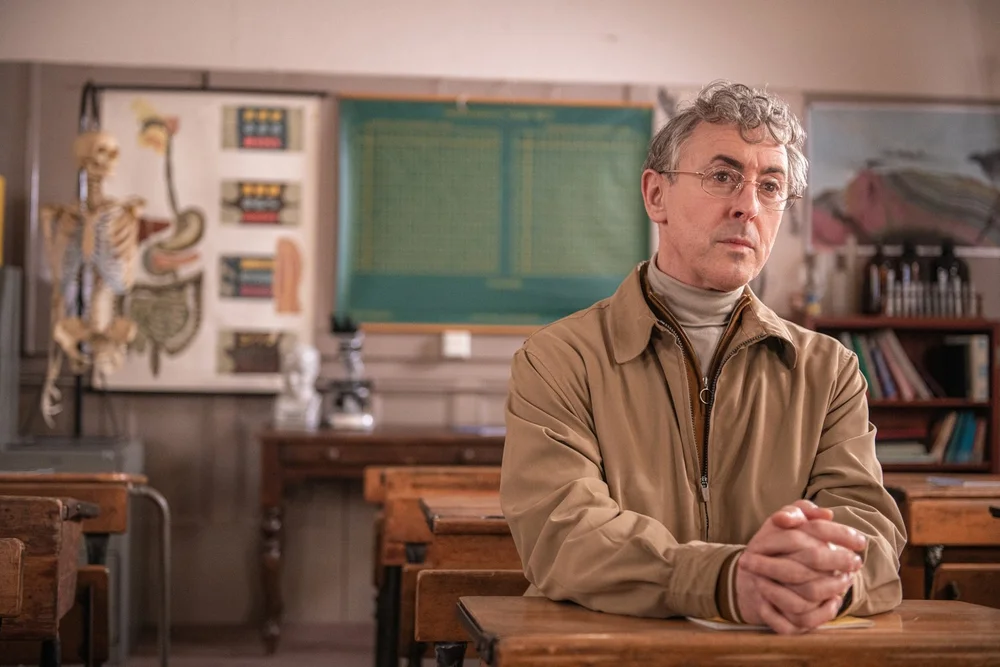
The answers to those two questions are where sympathy becomes the engine of surprise in My Old School. As the opening credits present, the subject of the film “doesn’t want to show his face,” but is willing to be heard. Instead, Emmy-nominated actor Alan Cumming steps in as the physical proxy of Brian MacKinnon to lip-synch the quirks of body language and expression in characterizing MacKinnon’s words.

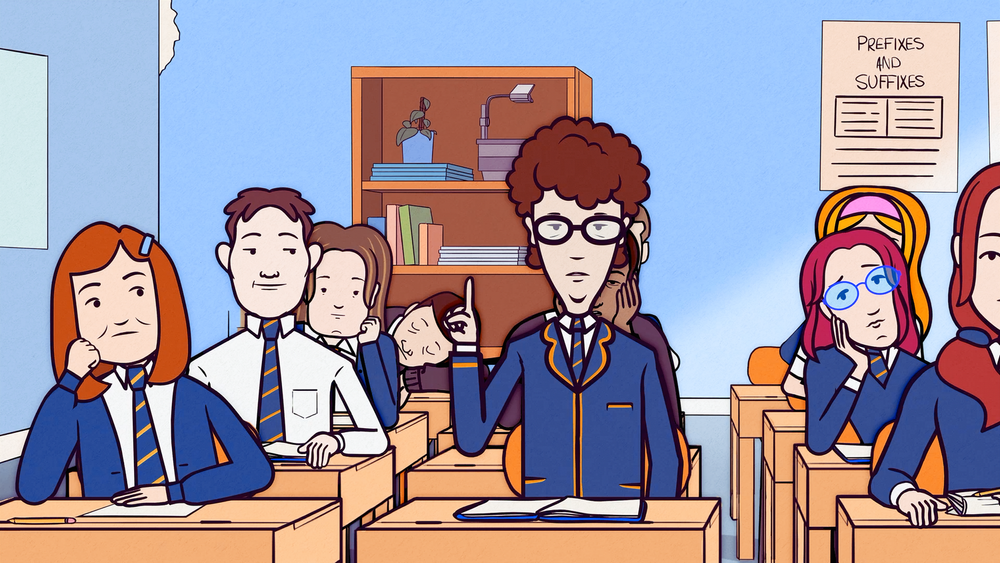
Concurrently, more than a dozen Bearsden grads, including documentary writer-director Jono McLeod, all now in their forties, and a few former staff members come on camera to look back on the enigma that was their former classmate and pupil. Adding artistic panache, animation director Rory Lowe (Hallam Foe) and lead animator Scott Morriss (The Brilliant World of Tom Gates) created several animated vignettes that cartoonishly flesh out the recollected events being described by the witnesses.

I’ll let the documentary’s many testimonies, including MacKinnon’s own, instead of this review fully reveal the what and why aspects. However, what can be discussed and critiqued is the connective and emotional appeal of My Old School. Just when you think this would be a string of vented outrage and disturbed reactions to evil-labeled deception that drops jaws and boils blood, the mood of the room could not be more temperate, right down to Shelly Poole’s fittingly quaint musical score.

LESSON #3: WHAT’S THE HARM?– What unfolds in My Old School is a multi-layered story that questions various levels of perceived or actual harm. To a man, each of these former friends and classmates have positive and even forgiving things to share about “Brandon Lee.” In large and small ways outside of the media frenzy fallout, the duplicitous man made a difference for many of them in a formative year of their lives. Their level of hurt, if there was one, has healed with comforting pity for the maligned Brian MacKinnon. 

MacKinnon’s own narrated admissions, including a 2002 video interview coda, convey a bracing honesty. He knows the listed wrongs of his actions. Still, the level of detail he put into this hoax and the relative ease by which it worked for its time is astounding. Brian’s tricky ingenuity is only outmatched by his conviction, one that continues to this day, for the betterment he was seeking through this attempted revamp towards his desired career path that would validate something meaningful for his life.

If you think My Old School would have made a compelling dramedy film, you wouldn’t be alone. As full-circle fate would have it, Alan Cumming was the actor originally attached to play MacKinnon for a theatrical treatment back in the late 1990s. The project never took off, so it’s a measure of sweet happenstance to see him in this special performance. His smirking charm and dancing eyes have not diminished with age. He submits a masterfully measured display of shrewd quirks to embody and extend the mystery. 

Combining Cumming’s lifting presence, snippets of archival TV coverage, and the animated sequences, My Old School has beguiling charm mirroring the fascinating central figure and the wry smiles on the faces of the Bearsden alumni telling their yarns. Viewers will absorb this tall tale and ask how much fraudulence is either acceptable or too much in a true-life “fake it until you make it” story. There is an irreverent delight to be had measuring that scale person-to-person and case-by-case.

3.png
2.png

LOGO DESIGNED BY MEENTS ILLUSTRATED (#1056)

Permalink


from Review Blog https://ift.tt/rLAnez7

Share:

PODCAST: Episode 72 of "The Cinephile Hissy Fit" Podcast

For their 72nd episode, two fed-up film critics, explosive dads, and stuntman school teachers Will Johnson and Don Shanahan got to have a full circle moment with the Russo brothers. Their follow-up to Cherry, on the first Cinephile Hissy Fit shows, is the new Netflix assassin action movie The Gray Man. Because both of our hosts like this movie against the norm, this episode spurred a detour into the current state of film criticism and whether or not critics can recognize or have fun anymore. You're going to get more of an earful on that topic than the movie, but it's a great conversation nonetheless. Come for the shared challenge and tirade and stay for the mutual love and respect for the fun movies encapsulate. Enjoy our podcast!


Cinephile Hissy Fits is a 25YL media podcast, brought to you by RuminationsRadioNetwork.com. Please visit, rate, review and subscribe. If you enjoyed this show, we have more where that came from, with interesting hosts, and wonderful guests. All available on iTunes, Spotify, and anywhere you find your favorite shows. Follow the show on Twitter at @CinephileFit and on Facebook. Also, find both Will Johnson and Don Shanahan on Letterboxd as the accumulate their viewings and build their ranks and lists.


Ruminations Radio Network website Spotify iTunes Transistor
Don Shanahan on Letterboxd Will Johnson on Letterboxd Don Shanahan on 25YL Will Johnson on 25YL

Permalink


from Review Blog https://ift.tt/Iox71Ha

Share:

Behind Closed Doors with Veronika Esslinger

Movie Marker Magazine sat down with actress Veronika Esslinger to talk acting, and latest role in the TV show ‘Legal Affairs.’ Have you always lived in Germany? Can you tell us a little about your early beginnings? Yes, I have always lived in Germany, in between, I was in Los Angeles for almost a year. […]

The post Behind Closed Doors with Veronika Esslinger appeared first on Movie Marker.


from Movie Marker https://ift.tt/DSXz5gV
Share:

MOVIE REVIEW: Relative

Images courtesy of New City Chicago

RELATIVE– 5 STARS

About two-thirds of the way into Relative, the new film from Chicago-based independent filmmaker Michael Glover Smith, the patriarch of the Frank family offers a toast to his college graduate son that perfectly encapsulates the winsome weight of the entire movie. Clinking glasses in a multidirectional fashion, the father quietly chants, “Not above you, not below, but right beside you.” The salute speaks to the unbreakable bonds of family and the ever-competing joys and burdens that are shared equally by all members.

LESSON #1: THE MANY MEANINGS OF “RELATIVE”– The delightful mirth of that toast is the warmth richly displayed in and typified by the title of Relative. It’s a perfect word for the film to mold and distinguish. Everyone is connected, yet no one is the same. Mindsets might be shared only to be differently interpreted person-to-person. It’s all just exactly the word: relative. As the film blossoms, the audience wonders how this particular family, the relative good ones and bad ones, end up the way they do. Lo and behold, that aforementioned toast becomes a tremendous turning point in the movie. 

Before that moment, Relative began with introductions of characters, their obligations elsewhere, and their traveling distances from the classic home of David and Karen Frank (Francis Guinan of Henry Gamble’s Birthday Party and Wendy Robie of Twin Peaks) in the diverse Rogers Park neighborhood on the far north side of Chicago. Their four adult children are reunited to celebrate the youngest, Benji (Chicago Fire actor Cameron Scott Roberts), receiving his undergraduate degree and being earmarked to work for Google in their geographic information systems department. The day’s festivities are in his honor, yet Benji is willing to ditch his own party to court his fetching theater major classmate Hekla (the debuting Elizabeth Stam). 

Benji moving out and starting his career would finally mean an empty nest for David and Karen if not for their eldest son Rodney (David F. Gallagher of Orders) occupying their basement. Rod is a military veteran in a rudderless place of angry despondency that has gone on for years. A bad breakup with Sarah (Collider’s Heather Chrisler), the mother of his bright son Davey (Gabriel Solis), has added to the pain.

Meanwhile, the two Frank daughters arrive from their respective married lives in the Quad Cities and Madison. Norma (Emily Lape of Mercy’s Girl) leaves her husband and children at home to make the trip solo, while Evonne (producer and burgeoning filmmaker herself Clare Cooney) and her partner Lucia (Grey’s Anatomy’s Melissa DuPrey) have brought their daughter Emma (Arielle Gonzalez) for the gathering. As people come together, Relative observationally tracks where everyone’s emotional states are at with their present situations beyond their childhood home.

LESSON #2: HOME IS THE GREATEST INTERSECTION OF LIFE– The hint is that this weekend is the first time in a long time everyone has been under the same roof. While two of the four Frank children have moved out with a third in Benji soon to do the same, the familial links between parents, children, and siblings still bleed through this old house. Production designer Stephanie McDonald and cinematographer Olivia Aquilina, both working their first feature film, created and occupied a lived-in setting emulating a safe space of belonging. Their work became a sturdy container for the magnetic moments of affection working to counter the repelling ruffles of strife among the Franks.

LESSON #3: THE DISINTEGRATION OF FAMILY– As teased, all is well and good for the most part until that toast. Afterwards, new announcements are made that threaten collapse for several pillars of this family unit. The casual conversations that started Relative to reveal little bits of individual and family history turn serious and soul-baring. How the family members react, heal, or move on from the revelations and shared quality time comprises the culmination of the extremely strong storytelling.

LESSON #4: DO WHAT YOU WANT TO DO— One standout quality of the merging stories being told in Relative is the welcome allowance for freedom within this family. Each person has their own very unique compass bearing that guides them. From the senior worries of aging parents to the trials and tribulations of the other romantic relationships present on down, there is a granted “do want you want to do” allowance for people to choose their own paths for happiness, which is something that should go for all of us watching the movie too. The appreciation present with the Franks is that, even if those choices come with great sacrifices or lead to setbacks, many of which come to light in the film’s conversations, there’s always the safety net of family. 

Continuing a masterful filmmaking strength for a fourth feature film, Michael Glover Smith (Mercury in Retrograde, Rendezvous in Chicago) has a superb gift for writing and directing conversations. It doesn’t matter if its two actors face-to-face, side-by-side, or a larger collection of mixed participants. It doesn’t matter if those talks happen in a quiet room, a serene spot outdoors, or a busy urban watering hole. Smith’s scripts move with a vivacious flow and carry a sophistication for allowing actors to create impressionable personalities from their characters, not just hit marks for dialogue dump or exposition delivery. This is, without a doubt, his best and fullest screenplay yet.

Smith adds even greater energy with a pitch perfect soundtrack, curated by music supervisor Cait Rappel, of moody instrumentals and indie singer-songwriters telegraphing moments with levity or lament that serve the intent of the matched scenes. For example, there is a delightful dance montage set to “Tisch Tennis” by Outrun, where labels and mindsets melt away for unbridled camaraderie. So much of the tone choices alongside the music are about steering character trajectories of who’s up, who’s down, who wants to rewind time, and who is accelerating towards something unknown.

The storytelling efficiency of Relative is marvelous. In a tidy 97 minutes, no less than nine adult characters enter this domestic intersection with arcs to frame and unite. Not a single one of the actors, along with the two child performers playing grandkids, are short-shrifted from receiving spotlight opportunities, meaningful scene involvement, or satisfying finishes. Some of the standouts among the remarkable cast are the “leave ‘em laughing” charisma from Elizabeth Stam, the hammer of pent-up stress released from Clare Cooney, and the soothing balm and lit cigarillos of Wendy Robie and Francis Guinan.  

A more possessive writer would pick their favorites for predictable perfection and sidebar the others to stock cliches. Some undisciplined mumblecore director would fail at tying them together at all and drop an opening ending that pisses momentum away. That’s not Relative, and that’s not Michael Glover Smith.

If Relative was trite, the plain circumstances or external vices would make everything turn out easily and conveniently. While family and good friends are the real answers for what makes matters of life easier, the effort of all involved to get there is hard. Smith understands that greatly, creating a relatable emotional obstacle course of cobwebs and intact skeletons in closets that promise to linger for future growth behind the credits. 

Live in this family for a bit. Soak in their aura. With a dynamite line in Relative, a suitor says to their prospective squeeze, “I could drink a case of you.” Let Smith’s words and his ensemble fill and stir the drink of your spirit. You’ll be intoxicated by the results. 

Relative (4).jpg
Relative (3).jpg
Relative (2).jpg
Relative.jpg
273831573_474897970798523_2369218767759367176_n (1).jpg
273903491_474898237465163_5862372977971296236_n (1).jpg
273883939_474897960798524_6313483494964677784_n (1).jpg

LOGO DESIGNED BY MEENTS ILLUSTRATED (#1053)

Permalink


from Review Blog https://ift.tt/xhqJLt2

Share:

Blog Archive

Recent Posts

Unordered List

  • Lorem ipsum dolor sit amet, consectetuer adipiscing elit.
  • Aliquam tincidunt mauris eu risus.
  • Vestibulum auctor dapibus neque.

Sample Text

Lorem ipsum dolor sit amet, consectetur adipisicing elit, sed do eiusmod tempor incididunt ut labore et dolore magna aliqua.

Ut enim ad minim veniam, quis nostrud exercitation test link ullamco laboris nisi ut aliquip ex ea commodo consequat.

Theme Support

Need our help to upload or customize this blogger template? Contact me with details about the theme customization you need.